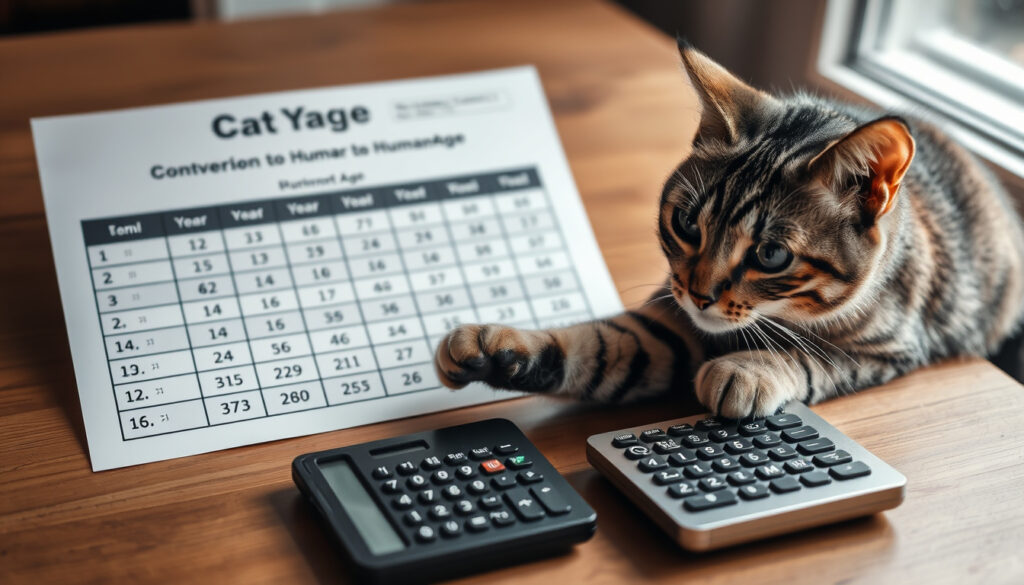
Cat Years to Human Years: Chart & Calculator
If you’ve ever wondered how old your cat really is in human years, you’re not alone. The old rule of thumb — multiply by seven — doesn’t hold up anymore. Veterinarians now use a more precise formula backed by organizations like the AVMA and AAFP, and once you see how the math works, it changes how you think about your cat’s life stages. This guide walks through the current standard, gives you a calculator to try at home, and covers what those numbers mean for your vet visits.
1 cat year: 15 human years · 2 cat years: 24 human years · Each additional cat year: 4 human years · 7 cat years: 44 human years · 13 cat years: 68 human years
Quick snapshot
- No peer-reviewed study validating exact human equivalents (Purina)
- Breed-specific aging differences not yet confirmed scientifically (Purina)
- Guidelines apply universally; regional variations not documented (Purina)
- AAHA/AAFP Feline Life Stage Guidelines updated March 2021 (AVMA JAVMA News)
- AAFP Senior Care Guidelines released June 2021 (AAFP)
- Increased emphasis on individual senior cat assessments over strict age thresholds
- More vets recommending semi-annual exams starting at age 7
- Owners can use these numbers to anticipate changing care needs
Five key data points, one pattern: the standard formula treats the first year as 15 human years, the second as 9 more, then adds 4 for every year after.
| Cat Age (years) | Human Equivalent (years) | Source |
|---|---|---|
| 1 | 15 | AVMA |
| 2 | 24 | AVMA |
| 3 | 28 | Purina |
| 5 | 36 | Purina |
| 7 | 44 | Purina |
| 10 | 56–60 | Purina, Chewy |
| 13 | 68 | Purina |
| 15 | 76 | Purina |
| 20 | 96 | Litter-Robot |
How to tell your cat’s age in human years
Standard conversion formula
The formula most veterinarians reference comes from a consensus approach rather than a single controlled study, but it has been adopted widely. According to the PetMD citing AVMA, a cat reaches roughly 15 human years by the end of its first year. The second year adds another 9 years, putting a 2-year-old cat at approximately 24 in human terms. From that point forward, each additional calendar year counts as about 4 human years.
Cats mature rapidly in their first two years, then aging slows down. Your 1-year-old cat is already a mid-teenager in human terms — not a toddler as many owners assume.
The math breaks down simply: Year 1 = 15, Year 2 = 9 more, then +4 per year. A 5-year-old cat, for example, works out to 24 + (3 × 4) = 36 human years, which matches the conversion shown on the Purina chart.
Factors affecting cat aging
Unlike dogs — where breed size dramatically affects aging rates — domestic cats age fairly uniformly across breeds. The Chewy education center notes that this lack of variation means the standard formula works reasonably well regardless of whether you have a Siamese, a Maine Coon, or a domestic shorthair. However, individual health, diet, indoor versus outdoor living, and genetics still influence how a specific cat ages in practice.
As the Purina article itself cautions: “There’s no reliable scientific way to calculate the relationship between human and cat years.” The formulas are approximations based on physiological development, not longitudinal studies. Keep that caveat in mind when planning care schedules.
The standard formula works across breeds, but individual factors mean your cat’s biological age may differ from the chart.
How old is 7 years in cat years?
Conversion for 7-year-old cat
A 7-year-old cat equals 44 human years. The calculation: 24 (for the first two years) + (5 × 4) = 44. At this point in a cat’s life, most are entering what veterinarians call the mature adult or early senior stage.
Senior care at this age
The PetMD, citing AAFP guidelines, notes that senior care often begins at age 7 — even though the official senior threshold sits at 10. This means a 7-year-old cat may benefit from more frequent vet checkups and dietary adjustments. The AAFP 2021 Senior Care Guidelines recommend exams every six months for cats aged 10–15, but many veterinarians suggest moving to that schedule earlier if the cat shows any signs of slowing down or weight changes.
Seven-year-old cats often look perfectly healthy, but they may be entering a phase where early intervention for issues like kidney function or dental health makes a real difference. Waiting for obvious symptoms can mean catching problems later than ideal.
The implication: scheduling a veterinary consultation at age 7—even for a seemingly healthy cat—can establish baseline values that make future health changes easier to detect.
How old is a 13 year old indoor cat?
Indoor vs outdoor aging
An indoor cat at 13 years old converts to 68 human years using the standard formula. Indoor cats typically age more slowly than outdoor cats because they face fewer risks — no traffic, fewer fights, no exposure to infectious diseases from other animals. The PetMD cites an average cat lifespan of 13–17 years, with indoor cats often reaching the upper end of that range.
Health at 13 years
At 68 in human years, a 13-year-old cat is solidly in senior territory. The AAFP 2021 Senior Care Guidelines call for veterinary visits every six months for cats aged 10–15, and every four months for healthy seniors over 15. Blood work, dental checks, and thyroid screening become especially important at this stage. The AAFP emphasizes that “veterinarians should consider four budgets of care: financial, time, emotional, and physical” when making treatment plans for senior cats.
What this means: a 13-year-old indoor cat at the equivalent of 68 human years deserves the same preventive care vigilance applied to elderly humans.
Is 7 considered old for a cat?
Defining senior cat stages
It depends on which guideline you reference. According to the AAHA/AAFP Feline Life Stage Guidelines, the stages break down as:
- Kitten: Birth to 1 year
- Young adult: 1–6 years
- Mature adult: 7–10 years
- Senior: 10 years and older
The AVMA confirms cats are considered senior after 10 years. So by that definition, a 7-year-old cat is not yet old — but is in the mature adult stage that many vets treat as a pre-senior transition period.
The myth of “1 cat year = 7 human years” is thoroughly debunked, but it persists because it’s simple. The actual formula produces much higher human-equivalent ages for young cats, which can surprise owners who aren’t prepared for how quickly cats reach maturity.
Signs of aging at 7
Even though 7 is not officially senior, cats at this age may start showing subtle signs that owners should monitor: decreased activity, changes in appetite or water intake, coat quality changes, or increased vocalization. These can be normal aging changes or early indicators of conditions like hyperthyroidism or kidney disease — both common in cats over 7.
The pattern: cats at 7 may already be experiencing physiological changes that routine bloodwork can detect before symptoms appear.
Cat years to human years calculator
Step-by-step conversion
You don’t need a special tool — just follow these steps:
- Take your cat’s current age in years.
- If your cat is younger than 1 year, the human equivalent is approximately 15 × (months ÷ 12). A 6-month-old kitten is roughly 7–8 human years.
- If your cat is 1–2 years old, use 15 for year 1 plus 9 for year 2. Any months beyond 2 years add proportionally.
- If your cat is older than 2, start with 24 and add 4 for every full year beyond age 2.
The Litter-Robot blog confirms this formula matches the standard widely cited across veterinary sources.
A 20-year-old cat reaches 96 human years — older than the oldest confirmed human. Yet the oldest known cat lived to 38, which would translate to well over 150 in human terms if the formula scaled linearly. No cat has actually reached that ceiling. The formula works best in the 0–20 year range where most pet cats live.
Chart for common ages
The AAHA publishes an official age chart poster (available as a downloadable PDF from their website) that includes both cat and dog conversions. The AAHA physiological age chart notes that a 6-month-old cat is already at approximately 10 human years in physiological terms — a useful reminder that cats develop far faster in their first months than most owners realize.
“Understanding the changing needs of each individual senior cat is critical for both veterinary professionals and cat owners.”
— American Association of Feline Practitioners, 2021 Senior Care Guidelines
“The Guidelines address the importance of regular veterinary visits which includes a minimum of every six months for senior cats 10 to 15 years.”
— American Veterinary Medical Association, Senior Pet Care Resource
What this means for cat owners: the formula gives you a useful shorthand for thinking about your cat’s life stage, but the real value is in using those stages to drive preventive care decisions. The numbers only matter if they change how you interact with your veterinarian.
Related reading: cat age chart in human years · cat years to human years
Our tool mirrors the veterinary-approved approach in this cat age calculator chart, which debunks the inaccurate multiply-by-seven rule with precise charts and formulas.
Frequently asked questions
How old is 10 cat years in human years?
A 10-year-old cat is approximately 56–60 human years. The range exists because some charts (like the one on Chewy) round to 60, while others using the strict formula arrive at 56.
How old is 3 cat years in human years?
A 3-year-old cat is 28 human years. This is calculated as: 24 (first two years) + 4 (one additional year) = 28.
How old is 11 cat years in human years?
An 11-year-old cat converts to approximately 60 human years. At this age, the cat is officially in the senior stage per AAHA/AAFP guidelines.
How old is 14 cat years in human years?
A 14-year-old cat equals roughly 72 human years. At this life stage, the AAFP recommends semi-annual veterinary exams at minimum.
What factors influence cat aging?
Individual health, diet, indoor versus outdoor living, genetics, and preventive veterinary care all affect how a cat ages. Unlike dogs, breed size does not significantly alter the cat aging rate.
When does a cat become senior?
According to the AAHA/AAFP Feline Life Stage Guidelines and confirmed by AVMA, cats officially become senior at 10 years. However, many veterinarians begin enhanced senior care screenings at age 7.
How to calculate cat age accurately?
Use the standard formula: Year 1 = 15 human years, Year 2 = 9 more (totaling 24), then add 4 human years for each year after age 2. For kittens under 1 year, approximate by months: a 4-month-old kitten is roughly 5 human years.
More related posts
 Malice at the Palace: Causes, Suspensions, and Aftermath
 Seahawks vs Tennessee Titans Match Player Stats – Box Score and Top Performers
 Mother’s Day Gift Ideas 2025: Top Picks for Mum in Ireland
 Spider-Man Brand New Day – Controversial 2008 Reset Explained
 Lucy in the Sky Brand Review: Shipping, Discounts & More
 Emily Alyn Lind Movies and TV Shows: Full Filmography
 Do Eyelashes Grow Back – Timeline Factors And Tips
 How to Track a UPS Package: Number, Phone & Online