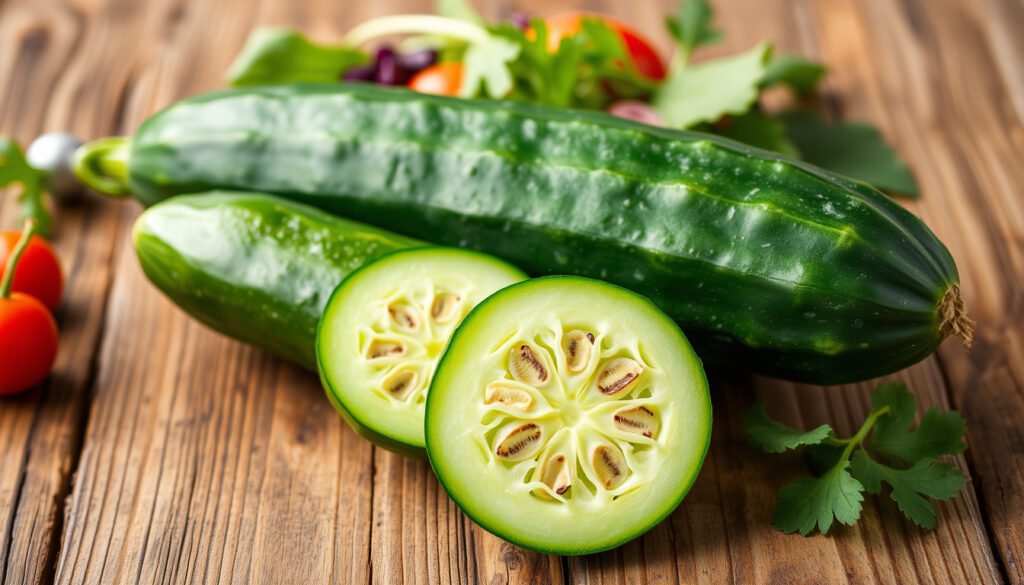
Is a Cucumber a Fruit? Botanical and Culinary Facts
When you’re slicing a cucumber into a salad, it’s easy to think of it as a crisp vegetable. But botanically, this green staple is actually a fruit — it develops from the flower of the cucumber plant and contains tiny seeds, according to the EU Food Information Council (EUFIC). Understanding this dual identity as a botanical fruit that’s almost always used as a culinary vegetable clears up a common confusion that trips up home cooks and gardeners alike.
Botanical classification of cucumber: fruit (pepo) ·
Culinary classification of cucumber: vegetable ·
Seed count per cucumber (avg): 100–300 seeds ·
Cucumber annual global production (FAO): ~90 million tonnes
Quick snapshot
- Cucumber is a botanical fruit (seed-containing, flower-derived) (Royal Botanic Gardens, Kew)
- Cucumber is a culinary vegetable (savory preparation) (Wikipedia)
- Exact historical origin of the culinary vegetable label for cucumber
- Whether regulatory definitions (e.g., USDA) align consistently with botanical classification
- Botanical classification established in 18th-century Linnaean system; culinary usage predates modern botany
- Use the dual classification to understand similar borderline foods: tomatoes, zucchini, peppers, pumpkins
| Attribute | Value |
|---|---|
| Botanical fruit type | Pepo (berry-like fruit) |
| Family | Cucurbitaceae (gourd family) |
| Culinary use | Savory, rarely sweet |
| Seed presence | Yes, 100–300 seeds per fruit |
| Annual global production | ~90 million tonnes (FAO) |
| Common preparation | Salads, pickles, raw consumption |
Is a cucumber a fruit or a vegetable?
Botanical definition of a fruit
Botanically, a fruit is the mature ovary of a flowering plant, usually containing seeds. The University of California, Davis Vegetable Research and Information Center defines fruit as the structure that develops from the ovary after flowering. Cucumbers fit this definition perfectly: they grow from the flower of the cucumber vine and hold 100–300 seeds inside. The New York Botanical Garden confirms that a fruit is the mature ovary of a flowering plant, while a vegetable is typically a leaf, stem, or root. Washington State University Extension adds that cucumbers are botanically fruits, alongside cantaloupe, peaches, watermelons, olives, avocados, and tomatoes (WSU Extension PDF).
The cucumber is a pepo, a type of berry with a hard rind. Wikipedia notes this classification, though it’s a tier‑3 source. The key takeaway: by every botanical criterion, cucumber is unequivocally a fruit.
Anyone who has ever wondered “is a cucumber a fruit?” gets a clear yes from botany. The plant’s flower origin and seed content leave no ambiguity — the confusion comes only from kitchen habits.
Culinary definition of a vegetable
In the kitchen, “vegetable” is a practical label for savory, non‑sweet plant parts. Cucumbers are almost never eaten in sweet preparations; they appear in salads, sandwiches, and pickles. The EU Food Information Council (EUFIC) explains that the culinary classification is based on taste and usage, not plant anatomy. Healthline adds that the savory profile drives the vegetable label. This dual system is why many produce items — tomatoes, zucchini, peppers — also straddle the line.
The implication: “vegetable” is a culinary convenience, not a scientific term. For a cucumber, calling it a vegetable in the kitchen is correct, but it doesn’t change the botanical reality.
Why is a tomato a fruit but a cucumber is a vegetable?
Tomato fruit vs cucumber fruit: botanical similarity
Both tomatoes and cucumbers are botanical fruits. They develop from flowers, contain seeds, and belong to the same classification as fruits. The Washington State University Extension lists both as examples of fruits that are often called vegetables. Yet in common language, tomato is frequently called a fruit (especially in science contexts), while cucumber is almost always called a vegetable. Why?
Historical culinary classification differences
The difference is culinary tradition. Dictionary.com notes that cucumber is “technically a fruit but usually treated as a vegetable.” Tomato, on the other hand, has a sweeter taste and is used in both savory and sweet dishes (sauces, ketchup, and occasionally jams). Cucumber rarely appears in sweet contexts. The 1893 U.S. Supreme Court case Nix v. Hedden ruled that the tomato is a vegetable for tariff purposes, reinforcing the culinary-legal classification. But no such case changed cucumber’s public perception — it remained firmly in the vegetable camp.
The pattern: culinary usage, not botany, determines everyday labels. For cucumber, the savory‑only tradition keeps it in the vegetable aisle.
Is cucumber a fruit or vegetable nutritionally?
Nutritional profile of cucumber
Nutritionally, cucumber behaves like a vegetable. A 100‑gram serving contains only 1.7 grams of sugar and 15 calories, with about 95% water (Healthline). This is far closer to lettuce or celery than to sweet fruits like bananas or apples. The NC State University Plant Toolbox describes cucumber as a “common vegetable grown for its crisp, green fruit” — reflecting the same dual identity.
Comparison to common fruits and vegetables
One fresh peach has about 13 grams of sugar; one cup of cucumber slices has under 2 grams. The glycemic load of cucumber is negligible, while sweet fruits can spike blood sugar. In dietary guidelines, cucumbers are grouped with vegetables because they contribute to the vegetable intake recommendation. The USDA’s MyPlate guidelines list cucumbers under “vegetables” (MyPlate).
The trade-off: calling cucumber a fruit nutritionally would be misleading. Its low sugar and high water content make it a vegetable by any practical dietary measure.
Is a zucchini a fruit?
Zucchini botanical classification
Zucchini, like cucumber, is a botanical fruit. It belongs to the same family, Cucurbitaceae, and is also a pepo — a fleshy fruit with a hard rind. Wikipedia confirms that zucchini is a fruit botanically but used as a vegetable. The Royal Botanic Gardens, Kew explains that the cucumber is a fruit, and by the same logic, zucchini is too.
Similarity to cucumber
Both cucumber and zucchini are summer squashes, harvested immature, and eaten raw or cooked in savory dishes. They share the same botanical structure — flowers develop into seeded fruits — and the same culinary fate. The NC State University Plant Toolbox classifies cucumber as Cucumis sativus; zucchini is Cucurbita pepo. Both are in Cucurbitaceae. The pattern: any fruit from this family that is eaten unripe and savory is a culinary vegetable.
Is a jalapeño a fruit?
Pepper fruit classification
Jalapeños are fruits by the same botanical definition. They develop from the flower of the pepper plant and contain seeds. UC Davis VRIC confirms that peppers are fruits botanically. The New York Botanical Garden also notes that peppers are fruits, as they are the mature ovaries of flowering plants.
Capsicum as berry
Botanically, a jalapeño is a berry — a type of fruit with a fleshy interior and seeds. This may surprise anyone who thinks of berries as small and sweet, but the term “berry” in botany includes peppers, tomatoes, and even bananas. Culinarily, jalapeños are treated as vegetables (or spicy seasonings), never as desserts. The same dual identity applies: fruit by science, vegetable by practice.
The catch: once you learn the botanical rule, you’ll see it everywhere — pumpkins, peppers, cucumbers, zucchinis, and tomatoes are all fruits masquerading as vegetables.
Six common produce items, one pattern: each is a botanical fruit but a culinary vegetable. The table below shows how they align.
| Food | Botanical classification | Culinary usage | Common label |
|---|---|---|---|
| Cucumber | Fruit (pepo) | Savory, raw, pickled | Vegetable |
| Tomato | Fruit (berry) | Savory and sweet | Fruit/Vegetable |
| Zucchini | Fruit (pepo) | Savory, cooked | Vegetable |
| Jalapeño | Fruit (berry) | Savory, spicy | Vegetable |
| Pumpkin | Fruit (pepo) | Savory and sweet pies | Vegetable |
| Bell pepper | Fruit (berry) | Savory, raw, cooked | Vegetable |
What’s clear and what’s not
Confirmed facts
- Cucumber is a botanical fruit because it develops from a flower and contains seeds (EUFIC)
- Cucumber is a culinary vegetable because it is used in savory dishes (Wikipedia)
- Many other produce items (tomato, zucchini, pepper, pumpkin) share the same dual classification
- The botanical definition of fruit is the mature ovary of a flowering plant (New York Botanical Garden)
What’s unclear
- Exact historical origin of the culinary vegetable label for cucumber
- Whether USDA regulations consistently apply the botanical or culinary definition for labeling
- Why some borderline foods (like tomato) are more often called fruit than others (like cucumber)
What the experts say
Cucumbers are classified as fruit because they contain tiny seeds in the middle and grow from the flower of the cucumber plant.
— EU Food Information Council (EUFIC)
The cucumber … is a widely-cultivated creeping vine plant bears cylindrical to spherical fruits, used as culinary vegetables.
— Wikipedia
For home cooks and gardeners, the choice is clear: call it a vegetable in the kitchen, but know it’s a fruit in the field. The next time you’re slicing a cucumber, you can appreciate that what you’re holding is a botanical fruit — one that’s been masquerading as a vegetable for centuries. For anyone who wants to understand food labels, the lesson is simple: context matters. Botanically, a fruit is defined by its structure; culinarily, by its taste. And cucumber, with its crisp, savory crunch, will always live in both worlds.
Related reading: Hot Chicken Near Me: Dublin Guide & Fast Food Facts
pressdeskly.com, journalijdr.com, culinaryartsswitzerland.com
Frequently asked questions
Is a cucumber a fruit or a vegetable?
Botanically, it’s a fruit — it develops from a flower and contains seeds. Culinarily, it’s a vegetable because it’s used in savory dishes. Both are correct depending on context.
Why is a tomato a fruit but a cucumber is a vegetable?
Both are botanical fruits. Tomato is sometimes used in sweet dishes, so it gets called a fruit more often. Cucumber is almost always savory, so it’s labeled a vegetable.
Is cucumber a fruit nutritionally?
No. Nutritionally cucumber is low in sugar (1.7g per 100g) and high in water, resembling vegetables more than sweet fruits.
Is a zucchini a fruit?
Yes, botanically it’s a fruit (pepo) and a member of the Cucurbitaceae family. Culinarily it’s a vegetable.
Is a jalapeño a fruit?
Yes, it’s a botanical fruit (a berry) because it develops from a flower and contains seeds. In cooking, it’s used as a vegetable or spice.
Is a pumpkin a fruit?
Yes, pumpkin is a botanical fruit (pepo). It’s used as a culinary vegetable in savory dishes and as a sweet pie filling.
Is corn a fruit?
Corn is a grain, which is a type of fruit (caryopsis) botanically. Culinarily it’s considered a starch or vegetable.
Why is strawberry not a fruit?
Strawberry is technically an aggregate accessory fruit — the fleshy part is not the ovary but the receptacle. The tiny seeds on the outside are the true fruits (achenes).
More related posts
 Words That Start With C: Complete List with Meanings & Examples
 Orange Dot on iPhone – Meaning, Causes and Fixes
 How Long Does Menopause Last? Average Duration & Stages
 Iowa State Cyclones Football: History, NFL Players & Ireland Game
 Old National Bank Login: Step-by-Step Guide & Troubleshooting
 Chronic Venous Insufficiency Symptoms – Signs, Stages, Relief
 The Lincoln Lawyer Season 4: Release Date, Cast & Final Season
 How to See Deleted Messages on iPhone: Step-by-Step