Basal Cell Skin Cancer: Symptoms, Treatment, and Prognosis
You notice a small, pearly bump on your cheek that won’t go away – it could be basal cell carcinoma, the most common skin cancer. While it rarely spreads, delaying removal can lead to local tissue damage and more complex surgery.
Most common skin cancer: Accounts for about 80% of all skin cancers ·
Annual new cases in US: More than 4 million ·
Metastasis rate: Less than 0.1% ·
Cure rate with early treatment: Over 95% ·
Occurs most frequently on: Sun-exposed skin (face, neck, arms)
Quick snapshot
- BCC is primarily caused by UV exposure (StatPearls (clinical reference database))
- BCC rarely metastasizes (American Cancer Society (cancer research organization))
- Early treatment is highly curative (American Academy of Dermatology (dermatologist association))
- Exact molecular triggers for aggressive BCC subtypes (StatPearls (clinical reference database))
- Whether long-term sunscreen use alone can prevent all BCC (AAD (skin cancer guidelines body))
- Optimal follow-up intervals after treatment (AAD (skin cancer guidelines body))
- BCC typically grows slowly over months to years (StatPearls (clinical reference database))
- Metastasis is extremely rare — less than 0.1% (American Cancer Society (cancer research organization))
- Consult a dermatologist for any suspicious skin spot (AAD (dermatology guidelines body))
- Early treatment yields cure rates above 95% (PubMed (European consensus guideline))
Five key figures, one clear takeaway: basal cell carcinoma is both extremely common and overwhelmingly non-aggressive — but early action makes all the difference.
| Attribute | Value |
|---|---|
| Most common skin cancer | Yes, accounts for ~80% of all skin cancers |
| Annual US cases | >4 million |
| Metastasis rate | <0.1% |
| Cure rate with early treatment | >95% |
| Common locations | Face, ears, scalp, neck, shoulders |
How serious is the basal cell?
Basal cell carcinoma is rarely life-threatening. According to the StatPearls (clinical reference database), it almost never metastasizes — the spread rate is less than 0.1%. When caught early, treatment is highly effective, with cure rates exceeding 95% as noted by the American Academy of Dermatology (dermatologist guidelines body).
The low metastasis rate can create a false sense of security. While BCC rarely kills, it can cause significant local destruction — especially on the face — if left untreated for years.
That said, serious complications do occur in a small minority — typically when tumors reach advanced stages or involve critical structures like the eye or ear. The American Cancer Society (cancer research organization) emphasizes that staging is rarely needed because most BCCs are cured before they spread. The implication: seriousness is a function of location and timing, not of the cancer’s inherent lethality.
What are the first signs of basal cell carcinoma?
The earliest warning signs can be subtle. A PMC/NIH review (peer-reviewed medical journal) says a biopsy should be performed on any lesion suspicious for BCC. The five classic warning signs include:
- An open sore that does not heal within 4 weeks
- A reddish patch or irritated area that persists
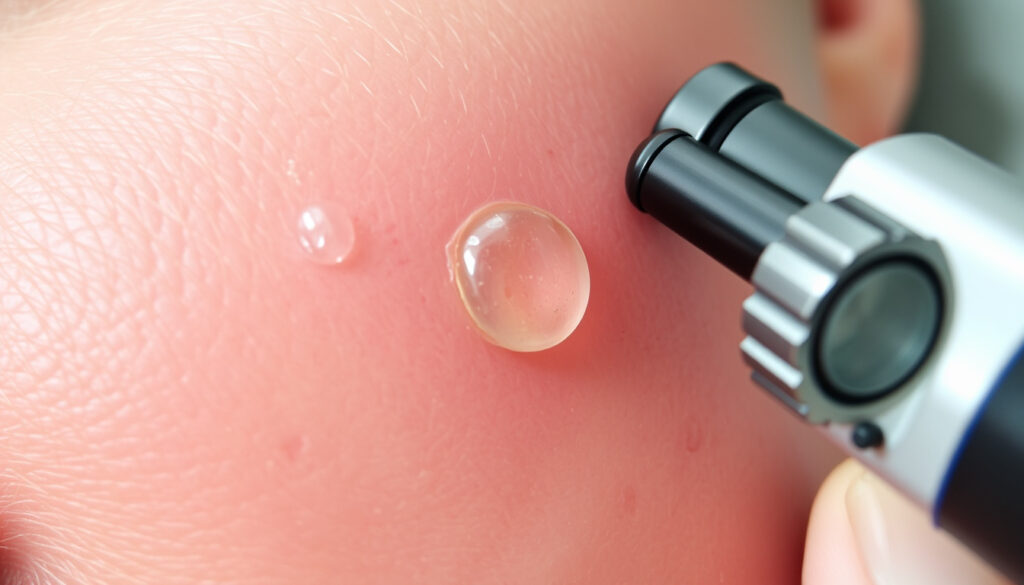
- A shiny, pearly bump — often translucent
- A scar-like area without a prior injury
- A pink growth with an elevated border and a crusted center
The American Academy of Dermatology (dermatology guidelines body) lists these as the most common presentations. Not every BCC looks the same, and some mimic benign spots.
What are the five warning signs of basal cell carcinoma?
| Warning sign | Typical appearance |
|---|---|
| Non-healing sore | Bleeds, oozes, or crusts for weeks |
| Reddish patch | May be flat or slightly scaly |
| Shiny bump | Pearly, dome-shaped, often with visible blood vessels |
| Scar-like area | White, waxy, without prior injury |
| Pink growth with rolled border | Elevated edge, crusted center |
The pattern: early BCC often looks innocuous. The catch is that many people mistake these for pimples or eczema, delaying diagnosis by months or even years.
If a spot on your sun-exposed skin doesn’t resolve within a month, a dermatologist’s exam can rule out BCC with a simple biopsy — a minor procedure that prevents a potentially disfiguring outcome.
Early detection turns a manageable problem into a minor procedure.
How long does it take for basal cell carcinoma to spread?
Most BCCs grow slowly — over months to years — as noted by StatPearls (clinical reference database). True metastasis is exceedingly rare, estimated at less than 0.1% by the American Cancer Society (cancer research organization). The vast majority remain localized and do not invade distant organs.
However, local invasion can be significant. An untreated BCC on the nose can grow into the nasal cartilage, requiring extensive reconstructive surgery. The European consensus guideline (interdisciplinary panel on skin cancer) recommends micrographically controlled surgery (Mohs) for high-risk and recurrent BCC at critical anatomical sites.
Your BCC may not spread to your lungs, but it can burrow deep into your cheek, eyelid, or ear — and the longer you wait, the more tissue a surgeon must remove to get clear margins.
The implication: slow growth means you have a window for action, but every month of delay risks deeper invasion.
How soon should you get basal cell carcinoma removed?
Most BCCs can be removed electively within weeks to months after diagnosis. The European interdisciplinary guideline (skin cancer surgery panel) states that first-line treatment is complete surgery. Earlier removal reduces the chance of local invasion and cosmetic damage. The American Academy of Dermatology (guidelines body) warns that delaying beyond 6 months may increase the risk of deeper growth.
Small, low-risk BCCs on the trunk may be safely observed for a short time, but any lesion on the face, scalp, or ear should be treated promptly. A National Cancer Institute (NCI) PDQ (cancer treatment database) lists treatment options including surgical excision, Mohs surgery, cryotherapy, and topical therapies — all with timing considerations.
Consult a dermatologist to determine optimal timing based on size, location, and histologic subtype. For patients who postpone, a reassessment every 3–6 months is advisable to monitor for growth.
The pattern: earlier removal equals smaller scar, less complex surgery, and lower recurrence risk. The catch: many people miss this window because they underestimate the disease.
Where is the most common place to get basal cell carcinoma?
BCC develops most often on sun-exposed skin. According to StatPearls (clinical reference database), common areas include the face (nose, eyelids, cheeks), scalp, ears, neck, shoulders, and back. It is less common on the trunk or areas not regularly exposed to UV.
The nose alone accounts for a high proportion of BCCs, likely because it receives the most direct sunlight. The American Cancer Society (cancer research organization) notes that cumulative sun exposure is the primary driver, which is why older adults and outdoor workers are at highest risk.
A single takeaway: if you spend significant time outside, regularly check your face, ears, and scalp — areas people often overlook.
What does stage 1 basal cell carcinoma look like?
Stage 1 BCC is small (usually less than 2 cm) and confined to the skin. The American Cancer Society (staging authority) explains that staging is rarely used for BCC because most are detected at stage 1 or earlier. It may appear as a small pimple, a pink lump, or a shiny spot with no ulceration.
There is no invasion into deeper tissues or lymph nodes at this stage. The National Cancer Institute (cancer treatment database) confirms that stage 1 BCC is highly curable with simple surgical removal — cure rates exceed 95%.
The key distinguishing feature: stage 1 lesions are often no bigger than a pea and have a characteristic “pearly” or waxy appearance. A AAD guideline (dermatology organization) recommends annual checks after treatment to monitor for recurrence or new primary skin cancers.
Stage 1 means now is the best time for treatment. Waiting until a lesion grows beyond 2 cm or invades deeper moves it into a higher-risk category where surgical options become more invasive and cure rates slightly diminish.
The catch: a small lesion today is a simple cure; a larger one tomorrow demands more.
Quotes from experts
“Basal cell carcinoma is the most common form of skin cancer, affecting millions each year. The good news is that when detected early, it is highly treatable.”
— Skin Cancer Foundation (national skin cancer education organization)
“BCC rarely spreads to other parts of the body, but it can cause significant local damage if left untreated — especially on the face where cosmetic and functional outcomes matter.”
— Mayo Clinic dermatologists (academic medical center)
“Regular skin checks are essential after a BCC diagnosis, because patients are at increased risk for both recurrence and new primary skin cancers.”
— American Academy of Dermatology (dermatologist professional society)
These expert statements reinforce the same message: treat early, treat completely.
Clarity check: what we know and what we don’t
Confirmed facts
- BCC is caused primarily by UV exposure (American Cancer Society (cancer research organization))
- BCC rarely metastasizes (American Academy of Dermatology (dermatologist guidelines body))
- Early treatment is highly curative (PubMed (European consensus guideline))
- BCC grows slowly (National Cancer Institute (cancer treatment database))
What’s still unclear
- Exact molecular triggers for aggressive subtypes (StatPearls (clinical reference database))
- Whether long-term sunscreen use alone can prevent all BCC (AAD (skin cancer guidelines body))
- Optimal follow-up intervals after treatment (AAD (skin cancer guidelines body))
- Whether all low-risk superficial BCCs are effectively cured by topical creams alone (AAD (dermatology guidelines body))
The confirmed facts offer a clear path: UV protection and early treatment. What remains uncertain are the details of prevention and follow-up.
For anyone who has noticed a suspicious spot on their skin, the decision is clear: see a dermatologist without delay, or risk allowing a manageable lesion to become a more complex problem that requires extensive surgery and recovery.
cancertherapyadvisor.com, skincancer.org, pinnacleskin.com, cancertherapyadvisor.com, moffitt.org, cancerresearchuk.org
For a detailed overview of its causes and prevention, readers can refer to detailed overview of its causes and prevention.
Frequently asked questions
Is basal cell carcinoma cancer?
Yes, it is a type of skin cancer that arises from the basal cells in the epidermis. The American Cancer Society (cancer research organization) classifies it as a non-melanoma skin cancer that is rarely life-threatening but may cause local tissue damage.
Can basal cell carcinoma be prevented?
Prevention focuses on minimizing UV exposure: using broad-spectrum sunscreen, wearing protective clothing, avoiding tanning beds, and regularly examining your skin. The AAD (dermatology guidelines body) emphasizes sun protection as the primary preventive measure.
Does basal cell carcinoma hurt?
In early stages, BCC is usually painless. However, the StatPearls (clinical reference database) notes that advanced lesions may become tender, bleed easily, or develop ulceration that causes discomfort.
What is Mohs surgery for basal cell carcinoma?
Mohs micrographic surgery is the most precise technique for removing BCC, offering the highest cure rate while preserving healthy tissue. The European consensus guideline (interdisciplinary skin cancer panel) recommends it for high-risk and recurrent BCC, especially on the face.
Can basal cell carcinoma recur after treatment?
Yes, recurrence is possible, particularly with high-risk subtypes or incomplete excision. The AAD (dermatology guidelines body) recommends annual full-skin examinations to monitor for recurrence and new primary skin cancers.
Are there different types of basal cell carcinoma?
Yes. Common histologic subtypes include nodular, micronodular, superficial, morpheaform, infiltrative, and fibroepithelial. Each behaves differently. The StatPearls (clinical reference database) notes that morpheaform and infiltrative subtypes are considered high-risk due to their tendency to recur locally.
More related posts
 NBA Play-In Tournament: Format and How It Works
 How to Track a UPS Package: Number, Phone & Online
 Emergency Plumber Near Me: Costs & When to Call (Ireland 2025)
 Rainbow Six Siege X: Free Access, Differences & Launch
 The Grinch 2000 Cast: Actors, Roles, and Where They Are Now
 LA Clippers vs Houston Rockets Match Player Stats: Box Scores
 How to Call Verizon Customer Service: Phone Numbers, Hours & Tips
 The Haunting of Bly Manor: Plot Twist and Hill House Link