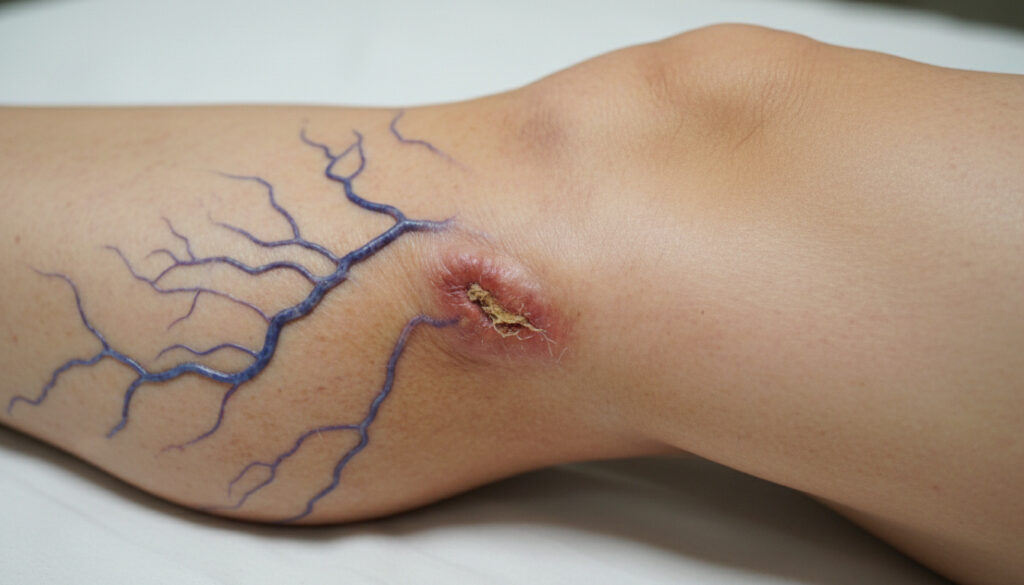
Chronic Venous Insufficiency Symptoms – Signs, Pain, Stages
Chronic venous insufficiency develops when the valves in your leg veins weaken or fail, allowing blood to flow backward and pool in the lower extremities. This circulatory dysfunction triggers a cascade of physical changes, ranging from subtle cosmetic concerns to debilitating skin ulcers. According to the Cleveland Clinic, approximately 150,000 new cases emerge annually in the United States, making early recognition critical for preventing irreversible tissue damage.
The condition rarely announces itself abruptly. Instead, patients typically experience a gradual onset of discomfort that intensifies throughout the day, particularly after prolonged periods of standing or sitting. Understanding these warning signals enables timely intervention before permanent vascular damage occurs.
Medical professionals classify venous insufficiency using specific symptomatic criteria that track disease progression from mild telangiectasias to active ulceration. Recognizing where you fall on this spectrum determines appropriate medical response.
What Are the Most Common Symptoms of Chronic Venous Insufficiency?
Patients with CVI present with a constellation of lower extremity complaints that reflect underlying venous hypertension. The National Center for Biotechnology Information notes that these manifestations result from sustained pressure within the superficial and deep venous systems, leading to fluid leakage and inflammatory changes in surrounding tissues.
Vein valves fail, causing blood to pool in legs rather than return to the heart efficiently.
Affects roughly 150,000 new patients yearly in the U.S., with higher rates in adults over 50.
Obesity, pregnancy, and occupations requiring prolonged standing significantly increase susceptibility.
Early symptoms respond to lifestyle modifications; delayed treatment risks permanent skin damage.
Key Clinical Insights:
- Symptom severity often correlates poorly with visible vein dilation; some patients experience significant discomfort before varicose veins appear prominent.
- Nocturnal leg cramps and restless leg sensations frequently represent early neurogenic manifestations of venous stasis.
- Pitting edema that worsens progressively from morning to evening serves as a hallmark physical finding distinguishing venous from arterial pathology.
- Patients with prior deep vein thrombosis carry substantially elevated lifetime risk for developing post-thrombotic syndrome and subsequent CVI.
- Cutaneous changes including hemosiderin deposition typically emerge months to years after initial symptomatic complaints.
- Delayed diagnosis correlates strongly with progression to venous ulceration, which affects approximately 1% of the adult population.
| Symptom | Description | Severity Level |
|---|---|---|
| Aching legs | Dull, persistent discomfort in calves or thighs, often described as heaviness or fatigue | Mild to Moderate |
| Swelling (edema) | Pitting indentation in lower legs/ankles that worsens by evening | Moderate |
| Varicose veins | Twisted, bulging vessels >3mm diameter visible beneath skin surface | Mild to Severe |
| Itching/discoloration | Pruritic, flaky skin with reddish-brown hyperpigmentation from capillary rupture | Moderate to Severe |
| Ulcers | Open, painful sores typically located near medial malleolus; resistant to healing | Severe |
| Burning/tingling | Paresthesia or “pins and needles” sensation exacerbated by dependency | Mild to Moderate |
What Are the Early Signs of Chronic Venous Insufficiency?
Recognition of incipient venous disease requires attention to subtle physiological shifts that precede visible structural changes. Premier Medical Group emphasizes that initial symptoms typically intensify during sedentary periods and resolve partially with leg elevation, distinguishing venous congestion from arterial ischemia.
Recognizing Initial Discomfort
The earliest perceptible indication often manifests as a vague sensation of heaviness or fullness in the calves during late afternoon hours. Patients frequently describe their legs as “tired” or “filled with lead,” sensations that improve dramatically overnight as gravitational effects diminish and venous return improves during recumbency.
Spider veins (telangiectasias) and reticular networks may appear as isolated cosmetic concerns years before functional symptoms develop. While these visible markers do not constitute diagnostic criteria for CVI independently, their presence signals underlying venous valve incompetence that may progress to symptomatic disease.
Nocturnal Manifestations
Nighttime leg cramps represent a frequently overlooked prodromal symptom. These painful muscle contractions differ from typical exercise-related cramping by their timing and association with restless leg sensations. Advanced Heart and Vascular Institute reports that patients often experience crawling or itching sensations deep within the extremities, prompting involuntary movement to relieve discomfort.
Interventions implemented during C0-C2 stages—before visible edema or skin changes develop—demonstrate significantly higher success rates in halting disease progression than treatment initiated after structural tissue damage occurs.
What Does Chronic Venous Insufficiency Pain Feel Like?
The somatic experience of venous insufficiency encompasses diverse sensory qualities that evolve alongside pathological progression. Unlike the sharp, exertional pain characteristic of arterial claudication, venous discomfort presents as a diffuse, aching pressure that builds progressively throughout waking hours.
Character and Quality
Patients characterize the sensation using descriptors ranging from throbbing and burning to deep muscular aching. Penn Medicine documentation identifies “heaviness” and “tightness” as particularly prevalent complaints, often accompanied by cutaneous hyperesthesia manifesting as tingling or “pins and needles” paresthesia.
The pain typically localizes to the gastrocnemius-soleus complex and medial ankle regions, corresponding to areas of highest venous hydrostatic pressure and subsequent capillary fragility. Warm weather and hormonal fluctuations may exacerbate subjective discomfort by inducing additional vasodilation.
Aggravating and Relieving Factors
Dependency—maintaining legs in a dependent position below heart level—consistently worsens symptoms by increasing gravitational resistance to venous return. Conversely, elevation above cardiac level typically provides rapid relief, often within minutes. This positional responsiveness serves as a diagnostic differentiator from peripheral arterial disease, where walking—not standing—precipitates pain.
How Do CVI Symptoms Progress Through Stages?
The Clinical-Etiology-Anatomy-Pathophysiology (CEAP) classification system provides a standardized framework for staging venous disease severity. Vein Health Clinics notes that formal CVI diagnosis requires progression to stage C3 or beyond, marked by the presence of edema.
The CEAP Classification Framework
Stage C0 represents subclinical disease where patients report symptomatic heaviness despite absent visible signs. C1 encompasses telangiectasias and reticular veins, while C2 indicates varicose vein formation exceeding three millimeters in diameter without accompanying edema. The transition to C3—persistent swelling without skin changes—marks the threshold for chronic venous insufficiency diagnosis.
Disease advancement typically follows a non-linear trajectory over months to years. High venous pressure eventually bursts capillary beds, depositing hemosiderin and creating the pathognomonic reddish-brown discoloration of stage C4.
Advanced Complications
Stage C4 introduces lipodermatosclerosis—indurated, hyperpigmented skin with marked texture changes. This fibrotic transformation reflects chronic inflammatory response to extravasated red blood cells and plasma proteins. Without intervention, tissue vulnerability progresses to healed ulceration (C5) and ultimately active open wounds (C6).
Venous ulcers—painful, shallow lesions typically located above the medial malleolus—develop in advanced stages due to severe edema and subsequent scar tissue formation. These wounds resist healing and carry significant infection risk, requiring urgent specialist evaluation.
How Does CVI Progress Over Time?
Understanding the temporal evolution of venous insufficiency enables patients to recognize their position within the disease continuum. Cleveland Clinic emphasizes that untreated CVI inevitably worsens, though individual progression rates vary based on compliance with compression therapy and activity modifications. Understanding the temporal evolution of venous insufficiency enables patients to recognize their position within the disease continuum, and for those dealing with more physical damage, learning how to Loch in der Wand reparieren can be a helpful skill.
- C0 (No visible signs): Subjective symptoms present without objective findings; “heavy leg” syndrome may occur.
- C1 (Spider veins): Telangiectasias or reticular veins appear as cosmetic concerns.
- C2 (Varicose veins): Dilated, tortuous superficial veins exceed 3mm diameter; may cause mild aching.
- C3 (Edema): Persistent pitting swelling without skin changes; formal CVI diagnosis threshold.
- C4 (Skin changes): Eczema, hyperpigmentation, or lipodermatosclerosis develop from chronic inflammation.
- C5 (Healed ulcer): Previous active ulceration has resolved, leaving scar tissue.
- C6 (Active ulcer): Current open wounds, typically near ankles, presenting infection risk and chronic pain.
What Symptoms Are Definite vs. Variable?
Medical consensus establishes certain physiological markers as definitive indicators of venous insufficiency, while other presentations demonstrate individual variability requiring careful differential diagnosis.
Established Indicators
- Pitting edema that worsens throughout the day and resolves with overnight elevation
- Cutaneous hyperpigmentation in the gaiter distribution from hemosiderin deposition
- Varicose veins with associated aching or heaviness
- Venous ulceration near the medial malleolus
- Symptom relief achieved through leg elevation rather than rest from walking
Variable Presentations
- Subjective pain severity, which may not correlate with visible disease extent
- Speed of progression from early to advanced stages
- Presence of nocturnal cramping or restless leg syndrome
- Degree of pruritus and dermatitic skin changes
- Response to conservative measures such as compression therapy
What Puts You at Risk for CVI Symptoms?
Venous insufficiency rarely occurs spontaneously; rather, it emerges from specific physiological stressors and genetic predispositions that compromise valvular integrity. Upstate Medical University identifies prior deep vein thrombosis as particularly significant, with post-thrombotic syndrome representing a major etiological category distinct from primary valvular failure.
Hereditary factors influence connective tissue strength and vein wall elasticity, explaining familial clustering of varicose veins. Mechanical risk factors—including obesity, multiparity, and occupations requiring stationary standing—exert sustained hydrostatic pressure that accelerates valvular degeneration. Age-related changes in muscle pump efficiency and vascular compliance further predispose older adults to symptom development.
Differentiating CVI from peripheral arterial disease (PAD) and deep vein thrombosis (DVT) remains crucial. PAD produces exertional calf pain relieved by rest—not elevation—and presents with cool, pale extremities. DVT constitutes an acute thrombotic emergency characterized by sudden unilateral swelling and pain, whereas CVI develops chronically. Maintaining cardiovascular health through regular activity, as discussed in Best Road Bikes 2025 – Top Picks from Expert Tests, supports venous return mechanisms, while understanding modern lifestyle patterns covered in Best Times to Post on TikTok – Data-Backed Schedule for Max Views highlights the sedentary behaviors that exacerbate venous stasis.
What Do Medical Authorities Say?
Leading medical institutions emphasize that early intervention prevents irreversible tissue damage. The Cleveland Clinic specifically highlights that patients often dismiss initial symptoms as normal aging or fatigue, delaying evaluation until ulceration develops.
Progression is gradual and usually worsens without treatment, from edema and fatigue to skin changes and ulcers over months or years. High pressure bursts capillaries, causing irreversible damage.
— Cleveland Clinic, Chronic Venous Insufficiency Overview
See a doctor promptly for new or persistent leg pain, swelling, varicose veins, skin changes, or tiredness; early intervention prevents ulcers and clots.
— Premier Medical Group, Signs of Venous Insufficiency
What Should You Remember About CVI Symptoms?
Chronic venous insufficiency announces itself through progressive leg discomfort, dependent edema, and cutaneous changes that intensify with prolonged standing and resolve with elevation. The condition advances predictably through CEAP stages from cosmetic vein abnormalities to potentially disabling ulceration, affecting approximately 150,000 Americans annually. Prompt medical evaluation at the first sign of persistent swelling or skin discoloration enables conservative management and prevents irreversible tissue damage.
Frequently Asked Questions
How does CVI differ from varicose veins?
Varicose veins represent a physical finding that may occur with or without CVI. Chronic venous insufficiency constitutes a functional diagnosis requiring symptoms like edema or skin changes (CEAP stage C3+), whereas varicose veins alone indicate only stage C2 disease.
What aggravates CVI symptoms?
Prolonged standing or sitting, heat exposure, high salt intake, and tight clothing around the waist or legs exacerbate venous pooling. Pregnancy and obesity increase abdominal pressure, further impeding venous return from the lower extremities.
Can CVI symptoms resolve without treatment?
Early symptoms may fluctuate but generally progress without intervention. While elevation and compression provide temporary relief, underlying valvular incompetence persists and typically worsens over time without medical management.
Is leg swelling always a sign of CVI?
No. Bilateral pitting edema may indicate cardiac, renal, or hepatic dysfunction. Unilateral sudden swelling suggests acute DVT. CVI-related swelling typically occurs unilaterally or bilaterally with dependent worsening and characteristic skin changes.
How quickly do CVI symptoms progress?
Progression varies by individual risk factors, ranging from months to decades. Patients with prior DVT, obesity, or hereditary vein weakness typically advance faster than those with primary valvular incompetence alone.
When does skin discoloration indicate serious disease?
Reddish-brown hyperpigmentation (hemosiderin staining) signals advanced capillary damage and stage C4 disease. This finding indicates high risk for progression to ulceration within months to years without aggressive intervention.
More related posts
 Flower Shops Near Me in Ireland: Florists vs Supermarkets
 REAL ID Exceptions: States, Alternatives & Black Star Guide
 Who’s Playing Monday Night Football Tonight? Schedule & Time
 Orange Dot on iPhone – Meaning, Causes and Fixes
 Cast of Highest 2 Lowest: Actors and Characters (2025)
 Children’s Dentist Near Me: Ireland’s Free Care & Rules
 Best Mexican Restaurant Near Me in Dublin, Ireland
 Do Eyelashes Grow Back – Timeline Factors And Tips