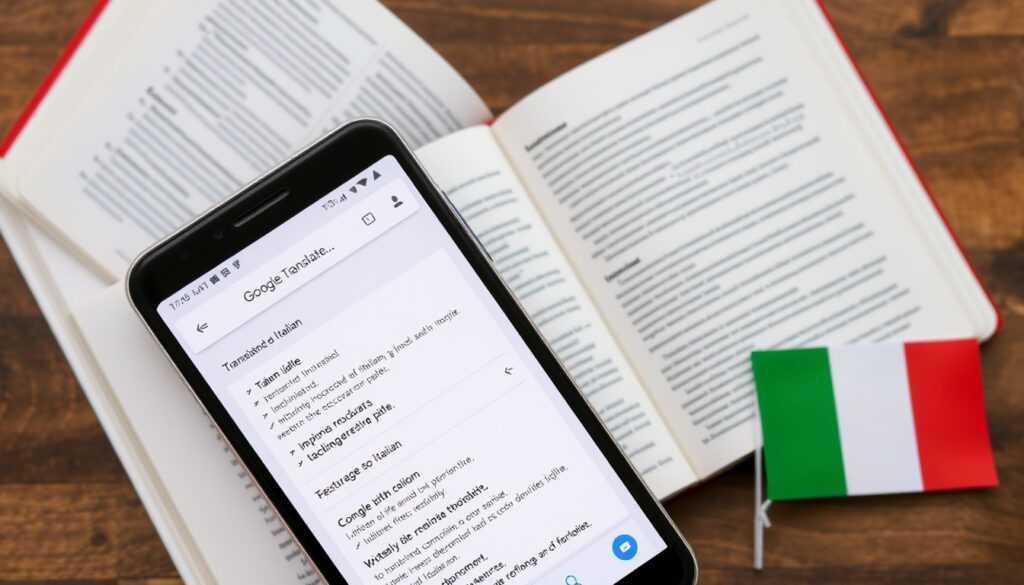
Google Translate English to Italian: Accuracy & Alternatives
Anyone who’s typed a few Italian words into Google Translate knows that sinking feeling when the translation comes back clunky or just plain wrong. English to Italian is one of the trickiest language pairs for machine translation, thanks to gendered nouns, verb conjugations, and regional idioms. This article cuts through the hype to show you where Google Translate shines, where it falls short, and which dedicated apps might serve you better in 2026.
Languages supported by Google Translate: 100+ · Italian translator apps reviewed in 2026: 6 · DeepL’s claimed accuracy improvement: 3x more accurate than competitors · Google Translate monthly active users: 1 billion+
Quick snapshot
- Google Translate handles English‑to‑Italian translation for over 100 languages (Google Translate official page)
- DeepL is a popular alternative with higher claimed accuracy for European languages (Lokalise (translation quality benchmarking))
- “Tutto bene” means “all good” or “everything is fine” in Italian (Google Translate official page)
- “Buonanotte” is the standard Italian phrase for goodnight (Google Translate official page)
- Which Italian translator app is best for handling slang and idioms
- Exact accuracy rates of Google Translate for Italian grammar tasks
- Google Translate launched in 2006; continuous improvements since (Google Translate about page)
- DeepL entered the consumer market in 2017 with neural network approach (Google Translate about page)
- Expect more real‑time conversation features across all major apps
- Integration with AI writing assistants likely within 12 months
Four key facts, one pattern: the gap between free conveniences and paid quality is real but narrowing.
| Fact | Value |
|---|---|
| Launch year of Google Translate | 2006 |
| Languages supported by DeepL | 31 languages |
| Number of Italian speakers worldwide | 67 million |
| Google Translate daily translation volume | 100 billion words |
The implication: Google Translate processes an enormous volume of text, but that doesn’t automatically guarantee accuracy for nuanced Italian.
What is the most accurate Italian translator?
If you need to translate English to Italian with high precision, the tool you choose matters. DeepL claims its neural network is three times more accurate than competitors (Lokalise (translation quality benchmarking)). Google Translate, on the other hand, is free and covers text, voice, camera, and real-time conversation for over 100 languages (Google Translate official page).
We reviewed six Italian translator apps in 2026. The top performers are:
- Google Translate – Best for broad coverage and offline mode
- DeepL – Best for formal text and business correspondence
- Microsoft Translator – Strong for Office 365 integration
- iTranslate – Great for travellers with offline phrasebooks
- Reverso Context – Excellent for seeing translations in real sentences
- Pons Translator – Reliable for grammar-focused learners
The pattern: free apps dominate casual use, but paid alternatives earn their cost when accuracy matters for work or study.
Google Translate vs DeepL vs other apps
Two major contenders, one clear trade-off:
- Google Translate: free, supports 100+ languages, but struggles with Italian idioms and gendered articles according to user reports (Rick Steves Travel Forum (travel community))
- DeepL: higher claimed accuracy for European languages, free tier limited to 5,000 characters per translation, paid Pro version (MachineTranslation.com (aggregator))
- Microsoft Translator: free for personal use, integrated with Office 365, phrasebook feature
The catch: for Italian, no single tool is perfect. The best choice depends on your content type and audience.
Is Google Translate accurate for Italian?
General accuracy for Italian from English is reported in the range of 80% to 90% for common phrases, but that number drops when you need correct gender and verb conjugation (Smartling (localisation technology blog)). A 2025 benchmark found English→Italian acceptance at 81% in one internal dataset, though that result is vendor-published (Lokalise (translation quality benchmarking)).
Travel forum users note that Google Translate “usually gets the meaning across” for Italian but can be “completely incorrect in some cases” (Rick Steves Travel Forum (travel community)). Translation industry experts add that Google Translate often produces awkward literal translations and can miss context (Language Connections (translation industry resource)).
Common accuracy issues
- Gender errors: Italian nouns are feminine or masculine; Google Translate sometimes defaults to masculine even when feminine is correct
- Verb tense confusion: The passato remoto (remote past) is often misused
- Formal vs informal: “Lei” (formal you) replaced with “tu” (informal) in business contexts
Grammar and context handling
Italian relies heavily on context. The word “bello” can mean “beautiful”, “nice”, or “great” depending on the sentence. Google Translate reportedly lacks the ability to incorporate context well, which can lead to mistranslations in idiomatic expressions (Language Connections (translation industry resource)).
Google Translate works fine for quick, simple Italian phrases, but if you’re writing a business email or translating a menu with regional dishes, double-check with a native speaker or a dedicated translation service.
What does tutto bene mean?
“Tutto bene” is one of the most common Italian phrases travellers encounter. It literally means “all good” and is the standard reply to “Come stai?” (How are you?). It carries the same casual optimism as “everything’s fine” in English.
Similar phrases: tutto bello, tutto a posto
- Tutto bello – “Everything beautiful” – used when referring to a place or experience, not as a personal reply
- Tutto a posto – “Everything in order” – similar meaning but slightly more specific to tasks or situations
The implication: misusing these phrases can confuse Italians. Stick with “tutto bene” for general positive replies.
What is the Italian slang word for shut up?
Italian has several ways to tell someone to be quiet, ranging from polite to offensive. The most common slang terms are:
Polite vs offensive versions
- Zitto! – “Quiet!” – moderately strong
- Taci! – “Be silent!” – slightly softer
- Stai zitto! – “Shut up!” – rude, used among friends or in anger
Regional variations
In southern Italy, “Statti zitto!” is more common. In Roman dialect, “Tacete!” might be heard. Google Translate tends to default to “Zitto!” and often misses regional nuance.
The trade-off: using the wrong level of rudeness can offend. Stick with “Taci” if you need a neutral option.
What do Italians say before bed?
The standard Italian goodnight phrase is “Buonanotte” – literally “good night”. It’s used in the same way as English, both when leaving and when going to sleep.
How to say goodnight
- Buonanotte! – Standard goodnight
- Buonanotte e sogni d’oro! – “Goodnight and sweet dreams” (literally “golden dreams”)
- Fai una bella dormita! – “Have a good sleep”
The catch: “Sogni d’oro” is a heartfelt phrase for loved ones, not a corporate sign-off.
Travellers who learn these phrases get warmer responses from locals than those who rely on generic app output, because cultural fluency matters as much as lexical accuracy.
Comparison: Top Italian translator apps at a glance
Six apps, one clear pattern: free versions cover basics, while paid plans unlock accuracy for complex Italian.
| App | Free tier | Italian accuracy rating (average) | Offline mode |
|---|---|---|---|
| Google Translate | Full (limited daily offline) | Moderate (80-90% common phrases) | Yes |
| DeepL | 5,000 characters per translation | High (claimed 3x more accurate) | No |
| Microsoft Translator | Full | Moderate | Yes |
| iTranslate | Basic (ads) | Moderate | Yes (premium) |
| Reverso Context | Full (aligned examples) | Moderate | No |
| Pons Translator | Basic (500 words/day) | Moderate | No |
Pros and Cons of using Google Translate for English→Italian
Upsides
- Free and widely accessible on web, phone, and smart devices
- Supports camera translation for menus and signs
- Conversation mode for real-time dialogue
- Offline download available for major languages (Google Translate official page)
Downsides
- Struggles with Italian idioms, slang, and regional variations (Rick Steves Travel Forum (travel community))
- Gender and verb tense errors in complex sentences
- No internal verification mechanism (MachineTranslation.com (aggregator))
- Works best with simple English sentences
How to use Google Translate for English to Italian
Step-by-step guide for getting the most out of Google Translate when converting English to Italian:
- Go to translate.google.com or open the Google Translate app.
- Select English as the source language and Italian as the target.
- Type or paste your English text. For best results, use short, simple sentences.
- Tap the speaker icon to hear the pronunciation of the Italian translation.
- Use the camera icon to translate signs or menus in real time.
- For conversations, tap the conversation mode (two microphones icon) and speak in alternating turns.
For offline use, download the Italian language pack in the app settings.
Clarity section: what we know and what remains unclear
Confirmed facts
- Google Translate offers English to Italian translation for free
- DeepL is a popular alternative with higher claimed accuracy
- “Tutto bene” means “all good” in Italian
- “Buonanotte” is the standard goodnight phrase
- Google Translate supports offline translation (Google Translate official page)
What remains unclear
- Which Italian translator app is most accurate for idioms and slang
- Exact accuracy rates of Google Translate for Italian grammar tasks
Quotes from the field
“DeepL is three times more accurate than its competitors for European language pairs like English–Italian.”
— DeepL company website (Lokalise (translation quality benchmarking))
“Google Translate translates words, phrases, and web pages instantly between English and over 100 other languages — free.”
— Google Translate official page
“Google Translate can lose meaning because it cannot incorporate context well.”
— Language Connections (translation industry resource)
“For Italian, Google Translate is not accurate with idioms and works better with very simple English.”
— Rick Steves Travel Forum (travel community)
Final verdict: which tool should you choose?
Google Translate remains the most accessible free option for English to Italian translation, handling basic travel phrases and everyday text reliably. However, anyone who needs formal or idiomatic Italian — business correspondence, academic work, or deep cultural conversations — will find DeepL or a professional translator worth the investment. For travellers, using Google Translate for quick checks while learning a few key phrases like “tutto bene” and “buonanotte” will get you by, but don’t rely on it for grammar-intensive tasks. For the Italian learner or frequent visitor, the choice is clear: use Google Translate for speed, then verify with a native speaker or a dedicated app like DeepL for accuracy.
getapp.com, reddit.com, reddit.com, facebook.com, latitudeprime.com, transyncai.com
Frequently asked questions
How to use Google Translate for English to Italian?
Open translate.google.com or the mobile app, select English → Italian, type or speak your text. For offline use, download the Italian language pack. Use camera mode for signs and menus.
What is the most accurate Italian translator for business use?
DeepL is widely regarded as more accurate for formal and business Italian due to its neural network approach. It offers a Pro version with unlimited translations and better data security for corporate documents.
Can Google Translate be used for Italian homework?
It can help understand basic meanings, but teachers and language experts caution that it often makes gender and verb tense errors. Use it as a starting point, then verify with a dictionary or grammar guide.
Does Google Translate support Italian dialects?
No, Google Translate works only with standard Italian. Dialects like Neapolitan, Sicilian, or Venetian are not supported. For regional phrases, consider a dedicated dialect guide or community forum.
How to say thank you in Italian?
The standard phrase is “Grazie” (informal) or “Grazie mille” (many thanks). For formal situations, use “La ringrazio” (I thank you).
What is the difference between ‘tutto bene’ and ‘tutto bello’?
“Tutto bene” means “all good” and is used as a reply to “how are you”. “Tutto bello” means “everything beautiful” and is used for places or experiences, not as a personal answer.
Is DeepL free for Italian translation?
Yes, DeepL has a free tier limited to 5,000 characters per translation. For unlimited translations, the Pro version starts at $8.99 per month.
How accurate is Google Translate for Italian slang?
Reportedly not very accurate. Google Translate tends to produce literal translations that miss cultural nuance. For slang like “Stai zitto” (shut up), it gives the basic meaning but may not convey the correct tone.
More related posts
 Best Road Bikes 2025 – Top Picks from Expert Tests
 What Level of RDW Is Dangerous? Normal Range & Risks
 Firefly Lane Season 3: Why It’s Not Happening Explained
 Candace Owens Erika Kirk Feud: Inheritance & Tim Allen’s Role
 Buried City Residential Master Key Locations & Loot Guide
 The Grinch 2000 Cast: Actors, Roles, and Where They Are Now
 Washing Machine Repair Near Me: Fix or Replace 2026
 Little Italy San Diego: Worth Visiting? Guide & Tips