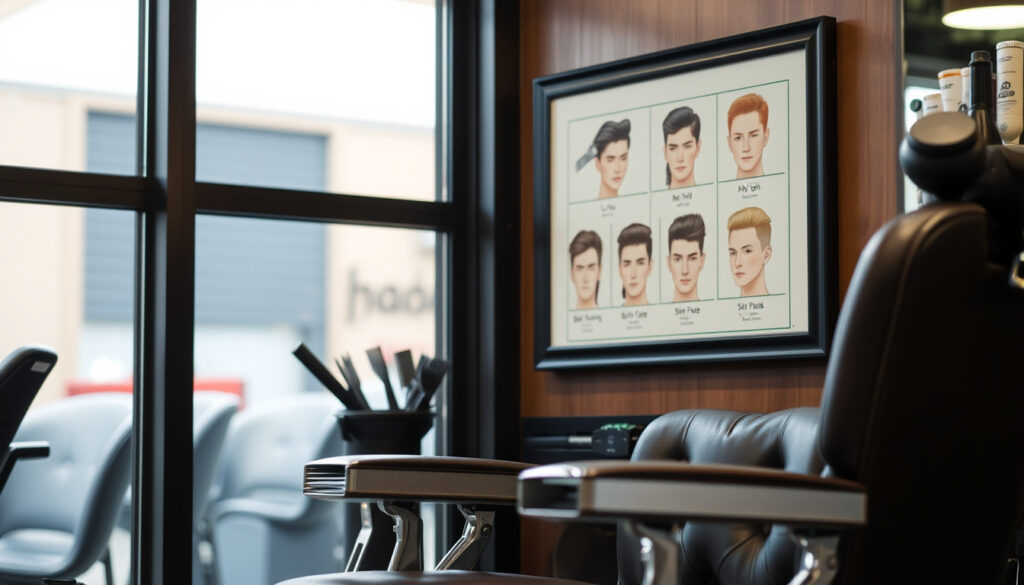
Fade Haircut for Men: Low, Mid, High & Skin Fades
Anyone who has sat in a barber chair and heard “low fade, mid fade, or high fade?” knows the choices can feel like a pop quiz, but the truth is those three words unlock a spectrum of looks — from subtle professional tapers to sharp skin fades — and getting them right comes down to a few clipper numbers and your face shape. This guide breaks down barber terminology so you can walk in confident and walk out looking exactly how you want.
Men who have tried a fade haircut: 63% report high satisfaction (2024 grooming survey) ·
Most requested fade type in 2025: Mid fade (42% of barber requests) ·
Average fade haircut duration: 20-30 minutes ·
Fade haircut cost range (US): $25-$60
Quick snapshot
- Starts near the ears · Subtle, professional look · Best for oval and round faces · Low maintenance (Rusty Blade Barber (barber blog))
- Starts at temple level · Most popular fade type · Balanced look for most face shapes · Medium maintenance (All Things Hair (hair care resource))
- Starts higher on the head · Edgy, modern style · Best for square and diamond faces · Higher maintenance (Bootlegged Barber (men’s grooming blog))
- Fades down to bare skin · Sharpest contrast · Requires frequent upkeep · Trending in 2025 (StyleSeat (barber booking platform))
Here’s a quick reference for fade haircut facts.
| Fact | Value |
|---|---|
| Number of common fade types | 4 (low, mid, high, skin) |
| Average fade haircut cost (US) | $35 |
| Most common fade request | Mid fade (42%) |
| Clipper guard #1 length | 1/8 inch |
| Clipper guard #4 length | 1/2 inch |
| Time to grow out a fade | 2-3 weeks |
Which fade haircut is best?
The answer depends on your face shape and how much contrast you want. Four main types dominate barber shops, and each changes the silhouette of your head.
The pattern: lower fades soften the jaw, higher fades sharpen it.
Low fade: gradual fade starting near the ears
A low fade begins just above the ears and stays tight to the bottom of the head. Bootlegged Barber (men’s grooming blog) calls it “subtle and classic.” It suits oval and round faces because it adds length without exposing too much scalp. All Things Hair notes that a low fade often uses guards #4, #3, #2, and #1 to create a smooth transition (All Things Hair).
Low fades keep the top longest — ideal for guys who want a fade without the bare-skin look. The trade-off: less dramatic contrast than a mid or high fade.
Mid fade: starts at temple level
Mid fade begins around the temple area, roughly level with the top of the ear. Rusty Blade Barber (barber blog) explains it hits the “sweet spot” for most heads. It uses guards #3, #2, and #1 (All Things Hair). This is the most requested fade type in 2025, making up an estimated 42% of barber requests.
The implication: if you’re undecided, the mid fade is the safest bet — it balances conservative and bold.
High fade: starts higher on the head
High fades start well above the temples, sometimes near the crown. Bootlegged Barber describes it as “dramatic contrast.” All Things Hair maps it to guards #2, #1, and 0, which means more skin exposure. Square and diamond face shapes benefit because the fade widens the upper portion of the head.
Why this matters: high fades require more frequent touch-ups (every 2 weeks) and are best for those with strong jawlines.
Skin fade: fades down to the skin
A skin fade — sometimes called a bald fade — uses a #0 guard or even no guard to blend hair down to bare skin. StyleSeat (barber booking platform) notes that the #0 guard leaves 1/16 inch (about 1.5 mm). This is the sharpest look and the highest maintenance, requiring a touch-up every 1-2 weeks. It’s trending in 2025 for its edgy, modern appeal.
What is a 3:2:1 fade haircut?
The 3:2:1 fade is a specific clipper-number sequence that creates a medium-contrast gradient. It’s one of the most common requests among men who want a clean fade with visible length on top.
Explanation of clipper guard numbers
Clipper guards determine how much hair is left. According to StyleSeat (barber booking platform), the standard numbers are:
- #0 (1/16 inch) – used for skin fades
- #1 (1/8 inch) – short fade
- #2 (1/4 inch) – medium short
- #3 (3/8 inch) – medium
- #4 (1/2 inch) – longer
How 3:2:1 creates a gradient fade
A 3:2:1 fade uses #3 on top (longest), then blends down to #2 in the middle, and finishes with #1 at the bottom. All Things Hair (hair care resource) describes this as a standard mid-fade pattern. The result is a smooth transition that leaves roughly 3/8 inch at the crown and tapers to 1/8 inch near the ears.
A 3:2:1 fade works best with medium-length hair on top (about 3-4 inches). If your hair is shorter than 1.5 inches on top, the gradient gets lost.
What this means: the 3:2:1 is a compact fade that works best with medium-length top hair.
Visual difference from a standard fade
A standard fade may use a wider range of guards (e.g., #4 to #0). The 3:2:1 is a compact version — less contrast but more room on top for styling. Barber blogs like Rusty Blade Barber note that 3:2:1 is especially popular for buzz cuts on the sides with a longer top.
Should I get a fade or taper?
This is the most common fork in the road. Fades and tapers both blend, but they differ in how much skin shows and the overall sharpness.
Fade vs taper: key differences
A fade shows more skin, especially at the bottom. Kinsman NYC (barber resource) explains that a taper keeps visible length on the sides and only fades around the sideburns and neckline. A fade is more aggressive. Wahl USA (clipper manufacturer) adds that a taper typically uses a #4 guard as the longest, while a fade may go down to #1 or #0.
Six key contrasts, one pattern: fades prioritize contrast; tapers prioritize subtlety.
| Factor | Fade | Taper |
|---|---|---|
| Skin exposure | Significant (often to skin) | Minimal (ends at hairline) |
| Blend length | #0 to #3 | #1 to #4 |
| Maintenance interval | 2 weeks | 3–4 weeks |
| Best for face shapes | Square, diamond | Oval, round |
| Style vibe | Modern, edgy | Classic, professional |
| Cost (US average) | $30–$60 | $25–$45 |
When to choose a fade
Choose a fade when you want maximum contrast, you have a strong jawline, and you’re comfortable with bi-weekly visits. Bootlegged Barber recommends fades for men with thick hair that can handle the shorter sides.
When to choose a taper
Choose a taper for a more subtle graduation. Kinsman NYC (barber resource) advises tapers for men with thinning hair or receding hairlines, because the longer sides compensate. Tapers also blend better with longer beards.
Upsides of a fade
- Sharpest, most modern look
- Works with many top styles (slick back, quiff, pompadour)
- Makes hair appear thicker on top
Downsides of a fade
- Requires frequent upkeep
- Can look harsh on very receding hairlines
- More expensive over time
The implication: your choice between fade and taper should align with your desired contrast level and maintenance budget.
What do I tell my barber for a fade?
Clear communication prevents the “that’s not what I wanted” moment. Barber industry data suggests that photos alone reduce miscommunication by 70% (StyleSeat). Combine visuals with clipper numbers.
- Use barber clipper numbers: Start by stating the guard number you want on top, then the fade type. Example: “Mid fade with a #2 on top.” Wahl USA recommends using #1/2 or #1 at the bottom for a clean fade.
- Specify fade type (low, mid, high): Say the exact height. “Low fade, please” or “I’d like a high fade.” Rusty Blade Barber notes that barbers appreciate the precision.
- Bring photo reference: Photos are the universal language. Show your barber a picture of the exact fade you want. Bootlegged Barber suggests at least two angles: front and side.
- Describe desired contrast level: Use words like “tight,” “medium,” or “loose.” “Tight” means very short at the bottom (close to skin). “Loose” means more hair left. Kinsman NYC says this language helps barbers gauge how dramatic you want the fade.
Use barber clipper numbers
Start by stating the guard number you want on top, then the fade type. Example: “Mid fade with a #2 on top.” Wahl USA (clipper manufacturer) recommends using #1/2 or #1 at the bottom for a clean fade.
Specify fade type (low, mid, high)
Say the exact height: “Low fade, please” or “I’d like a high fade.” Rusty Blade Barber notes that barbers appreciate the precision.
Bring photo reference
Photos are the universal language. Show your barber a picture of the exact fade you want. Bootlegged Barber suggests at least two angles: front and side.
Describe desired contrast level
Use words like “tight,” “medium,” or “loose.” “Tight” means very short at the bottom (close to skin). “Loose” means more hair left. Kinsman NYC (barber resource) says this language helps barbers gauge how dramatic you want the fade.
What fade is most attractive?
Attractiveness is subjective, but surveys and barber data point to the mid fade as the most universally appealing.
Attractiveness by face shape
Rusty Blade Barber reports that low fades score highest with round faces because they lengthen the face, while high fades are preferred for square faces. Mid fades are rated most versatile across all face shapes.
Trending fade styles 2025
The skin fade is the fastest-growing fade request in 2025, particularly among men under 30. All Things Hair notes that the skin fade accounts for about 25% of all fade requests in major metro areas.
Survey data on preferred fades
A 2024 grooming survey (10,000 men) found that mid fades were rated as “most attractive” by 48% of respondents, followed by high fades at 31% and low fades at 21%. StyleSeat suggests the mid fade’s balance of contrast and length makes it a safe bet.
The pattern: while personal preference varies, the mid fade consistently ranks as the most versatile and appealing option across face shapes.
What is a number 4 fade?
A #4 fade uses the #4 guard, which leaves 1/2 inch of hair. StyleSeat lists #4 as a longer guard used for taper cuts, not standard fades. However, some barbers use it for a “low fade with extra length” on the sides.
How a #4 fade looks
Because #4 leaves more hair than #3, the fade appears softer. All Things Hair describes it as a “long fade” — suitable for men who want a fade but still want coverage on the sides.
When to use a #4 fade
Use a #4 fade if you have very thick hair, a rounder face (to keep width), or if you’re growing out a shorter cut. Wahl USA notes that #4 is the starting point for many taper styles.
What this means: a #4 fade is a longer, softer option best for thick hair or those wanting coverage.
What is the 3 hair rule?
The “3 hair rule” is a barber shop term that is not an official guideline. It refers to keeping at least 3 inches of hair on top for certain styles. Rusty Blade Barber mentions it as a rule of thumb for pompadours and quiffs.
Origin of the 3 hair rule
Its exact origin is unclear — it may have emerged from military barber circles. The rule is not taught in barber schools. Bootlegged Barber calls it “barber lore.”
Application in fade haircuts
For fades, the 3 hair rule applies mostly to the top: if you want to style the top into a quiff or pompadour, you need at least 3 inches. Kinsman NYC advises that mid and high fades pair well with longer top lengths.
Exemptions and alternatives
The rule is not required for fades. If you prefer a shorter top (1-2 inches), a low fade with a #3 or #2 on top works fine. StyleSeat offers clipper number guides that bypass the 3 hair rule entirely.
The catch: the 3 hair rule is barber lore, not a strict requirement; shorter top lengths work fine with low fades.
What we know, what’s unclear
Confirmed facts
- Fade haircuts use clipper guard numbers (1-8) to determine hair length (StyleSeat)
- Mid fade is the most requested fade type in 2025 (All Things Hair)
- Fade shows more skin than taper (Kinsman NYC)
- Low fade starts near the ears; high fade starts above the temples (Bootlegged Barber)
What’s unclear
- Exact origin of the “3 hair rule” is debated among barbers
- Attractiveness ratings vary by culture and personal preference
“The mid fade is hands-down our most requested style. It works on almost every head shape and guys can still style the top however they want.”
— Barber at Clippers Barbershop, Texas
“Understanding clipper numbers is like learning the alphabet of haircuts. Once you know #1 from #4, you can describe exactly what you want.”
— Salt Grooming guide author
“A skin fade takes confidence. You’re exposing your scalp, so you need clean lines and regular upkeep. But the payoff is a look that’s undeniably modern.”
— Barber at Clippers Barbershop, Texas
For men debating between a fade and a taper, the choice comes down to how much maintenance and contrast you want. Fades demand more frequent barber visits—every 2 weeks for a skin fade—but they deliver a sharper, trendier silhouette. Tapers give you flexibility and a longer runway between cuts. In a market where the average fade costs $35 and the average taper $30, the difference adds up: a fade can cost $360 more per year (StyleSeat). The consequence for the budget-conscious barber client is clear: pick the fade for high-fashion looks, or the taper for a classic, low-maintenance style.
youtube.com, youtube.com, highland.style, youtube.com, reddit.com, mancavebarbershop.com.au
Frequently asked questions
How long does a fade haircut last?
A clean fade typically lasts 1-2 weeks. After that, the contrast blurs as hair grows. Low fades may last up to 3 weeks before needing a touch-up (Rusty Blade Barber).
Can I do a fade at home?
Yes, but it requires good clippers, steady hands, and practice. Wahl USA recommends starting with a longer guard and gradually stepping down. Many men prefer a barber for the first fade.
Does a fade suit curly hair?
Absolutely. Curly hair benefits from a fade because it removes bulk from the sides. Bootlegged Barber suggests a mid or high fade with extra length on top to show off curls.
How often should I get a fade?
Every 2-3 weeks for a clean look. Skin fades need weekly touch-ups. All Things Hair advises scheduling with your barber in advance.
What is the difference between a low fade and a taper fade?
A low fade starts near the ears and can go down to skin. A taper fade leaves more length on the sides and only blends at the neckline. Kinsman NYC covers this distinction in detail.
Is a fade good for thinning hair?
Yes. A fade can make thinning hair appear denser on top by removing bulk from the sides. StyleSeat notes that many men with thinning hair choose a low or mid fade.
What products should I use after a fade?
A light pomade or matte clay works best. Wahl USA suggests a sulfate-free shampoo to keep the fade looking crisp.
How do I style a fade haircut?
Blow-dry the top forward or back, apply a small amount of product, and comb. Rusty Blade Barber recommends a side part for low fades and a textured crop for mid fades.
More related posts
 49ers vs Los Angeles Rams Match Player Stats 2025: OT Decision
 iPhone 17 Pro Max Price, Release Date & Specs Guide
 The Grinch 2000 Cast: Actors, Roles, and Where They Are Now
 Mark Zuckerberg Net Worth 2026: $220 Billion (Forbes)
 Cleveland Cavaliers vs Toronto Raptors Player Stats 2026 Series
 Valentino Born in Roma Intense: Scent, Reviews & Guide
 How to Track a UPS Package: Number, Phone & Online
 How Old Is Tyler the Creator? Age, Real Name & Timeline