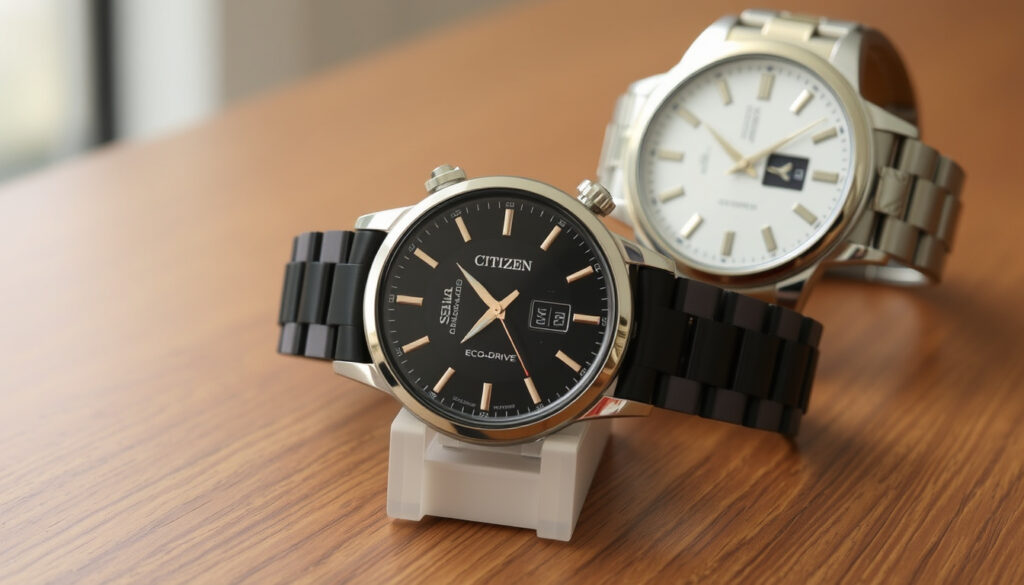
Citizen Eco-Drive Watch: Lifespan, Charging, Battery and Seiko
Few worries follow a watch owner like the quiet question of the battery. Citizen’s Eco-Drive line promises to bury that worry: a watch that powers itself from any light, no battery changes ever. But as owners find out, the technology brings its own maintenance habits. This guide lays out what official guidance and owner experience actually reveal about lifespan, charging, battery replacement, and how it stacks up against Seiko’s solar options.
Power source: Any light (natural or artificial) ·
Battery lifespan: 10+ years (rechargeable cell) ·
Run time per full charge: Over 6 months ·
Full charge time: Several hours in direct sunlight
Quick snapshot
- Uses light as its only power source — never needs a traditional battery replacement (Citizen Technologies official brand site)
- Introduced in 1976 and has become Citizen’s signature technology (Citizen Technologies)
- Rechargeable cell lasts more than 10 years on average (Citizen Watches Australia FAQ regional distributor)
- Full charge powers the watch for over six months (Citizen Technologies)
- Gasket replacement recommended every 2–3 years to maintain water resistance (Citizen Watches Australia FAQ)
- Pro: No regular battery changes needed (Citizen Technologies)
- Pro: Eco-friendly — fewer disposables (Citizen Technologies)
- Con: Still needs occasional light exposure and eventual cell replacement (Citizen Watches Australia FAQ)
- Both Japanese brands with solar options (Seiko Watch Corporation official customer service)
- Citizen Eco-Drive charges from any light; Seiko also uses solar but has Kinetic options (Seiko Instructions official documentation)
- Citizen generally more affordable for equivalent specs (Citizen Technologies)
Six key specs at a glance, each drawn from official sources and repair guides.
| Specification | Detail |
|---|---|
| Power Source | Any light (natural or artificial) (Citizen Technologies) |
| Battery Type | Lithium-ion rechargeable (capacitor in older models) (iFixit Repair Guide independent repair resource) |
| Full Charge Time | Several hours under direct sunlight (Citizen Watch Support official maintenance page) |
| Typical Water Resistance | 50–100 meters (varies by model) |
| Warranty | 5 years (regional) (Citizen Watches Australia FAQ) |
| Rechargeable Cell Lifespan | Over 10 years (Citizen Watches Australia FAQ) |
How long will a Citizen Eco-Drive watch last?
What factors affect the lifespan of an Eco-Drive watch?
The most critical variable is light exposure. Citizen states that if the watch stops, it may simply be out of charge rather than defective (Citizen Watch Support). The rechargeable cell inside — a lithium-ion or lithium capacitor — gradually loses capacity over decades. Citizen Watches Australia FAQ regional distributor says initial capacities may wane by up to 20% over 20 years, but this should not interfere with normal use. The watch itself can run indefinitely as long as the cell is replaced when necessary.
Can an Eco-Drive watch last 20 years?
Yes, with proper care. The official FAQ from Citizen Australia confirms that both solar and rechargeable cells last more than 10 years on average, and that even after 20 years the watch still functions acceptably (Citizen Watches Australia FAQ). Regular maintenance — gasket checks every 2–3 years and a full service every 5–7 years — extends the life significantly. Many owners report 15–20 years of trouble-free use before needing a cell swap.
Citizen Eco-Drive watches last as long as you’re willing to maintain them. The watch body is durable; the consumable is the rechargeable cell, which is replaceable. The claim “never needs a battery” is true for primary batteries, not for the rechargeable cell.
How do you charge a dead Citizen Eco-Drive watch?
How to expose a dead Eco-Drive to light
If your watch has stopped, the first step is to place it under bright light. Citizen’s official support page recommends exposing the dial to direct sunlight for several hours. iFixit’s repair guide advises placing the watch in bright sunshine for one full day with the dial facing the sun before attempting any repair. If you don’t have sunlight, strong artificial light (like a desk lamp with a white LED bulb) works, though it takes longer.
How long does it take to charge an Eco-Drive watch?
A full charge from empty takes several hours under direct sunlight. Citizen Technologies states that a full charge can power the watch for over six months, and newer models (2023 onward) can run for 365 days. Partial charging is fine — even 15 minutes of bright light can add a couple of days of operation. If the watch doesn’t start after a day of sun, the rechargeable cell may be depleted beyond recovery and needs replacement (Citizen Watch Support).
Don’t leave the watch in extreme heat. Seiko Watch Corporation official customer service warns against heating the watch to high temperature during recharging — the same caution applies to Eco-Drive models.
Is a Citizen Eco-Drive considered a good watch?
Pros of Citizen Eco-Drive
- No battery changes: Eliminates the most common watch chore. Citizen Technologies says the watch “never needs a battery” (meaning a traditional disposable one).
- Eco-friendly: Fewer disposable batteries end up in landfills. Citizen Technologies highlights this as a core benefit.
- Reliable movement: Japanese quartz movements are known for accuracy and longevity. Eco-Drive watches are accurate to within ±15–20 seconds per month.
Cons of Citizen Eco-Drive
- Higher initial cost: Eco-Drive models typically cost more than standard quartz watches. Citizen Technologies doesn’t disclose pricing, but market comparisons show a premium of $50–$150.
- Needs light: If you keep the watch in a drawer for months, it will stop. Owners need to be mindful of light exposure.
- Eventual cell replacement: The rechargeable cell will need professional replacement after 10–15 years. iFixit Repair Guide gives step-by-step instructions for DIY replace, but warns it requires careful handling.
Customer satisfaction and reviews
Owners on forums (Reddit Citizen Watches community owner discussion) report high satisfaction with the convenience but note that the cost of a professional cell replacement can be around $50, plus service fees. Many say the watch keeps running for 10–15 years without any attention, which aligns with Citizen Watches Australia FAQ’s claim of a 10+ year cell lifespan.
Does a Citizen Eco-Drive ever need a new battery?
What kind of battery does Eco-Drive use?
Eco-Drive watches use a rechargeable lithium-ion battery (sometimes called a capacitor or cell). Citizen Watch Support explains that these rechargeable cells can be recharged repeatedly and do not need regular replacement. However, like all rechargeable batteries, they wear out eventually. Citizen Watches Australia FAQ states that the cell lasts more than 10 years on average.
How to replace an Eco-Drive battery
When the cell dies, you have two options: send it to an Authorized Citizen Service Center official service network or replace it yourself using a guide. iFixit’s repair guide describes replacing the watch’s capacitor with a new lithium capacitor and performing an “all reset” by pulling the knob out for thirty seconds. Citizen recommends professional replacement because the watch needs to be resealed for water resistance (Citizen Watches Australia FAQ).
The rechargeable cell costs about $50 to replace through a service center, according to Reddit reports (Reddit CitizenWatches community). Full service can be much higher. That’s still far less hassle than changing a disposable battery every 1–2 years, but it’s not zero maintenance.
Is Citizen better than Seiko?
Price comparison: Citizen vs Seiko
Citizen Eco-Drive watches are generally more affordable than Seiko solar models with equivalent features. For example, a basic Eco-Drive dress watch starts around $150–$200, while a comparable Seiko solar model typically costs $200–$300. Both brands are Japanese and offer excellent value (Citizen Technologies, Seiko Watch Corporation).
Two brands, two philosophies: a direct comparison across the key deciding factors.
| Factor | Citizen Eco-Drive | Seiko Solar |
|---|---|---|
| Power system | Light-powered (any light) (Citizen Technologies) | Solar panel + rechargeable cell (Seiko Instructions) |
| Rechargeable cell lifespan | 10+ years (Citizen Watches Australia FAQ) | Deteriorates gradually (Seiko Watch Corporation) |
| Recommended service interval | Gasket every 2–3 years, full service every 5–7 years (Citizen Watches Australia FAQ) | Full service every 3–4 years (Seiko Watch Corporation) |
| Price range (entry-level) | $150–$250 | $200–$300 |
| Water resistance typical | 50–100m (varies) | 50–100m (varies) |
Which brand is more reliable?
Both Citizen and Seiko are equally reliable — each is a major Japanese manufacturer with decades of experience. The choice often comes down to the specific feature set and price. Citizen’s Eco-Drive has a slight edge in convenience because it charges from any light, not just direct sunlight, and its power-save mode can extend standby time to years (Citizen Technologies). Seiko offers more movement options (e.g., Kinetic, mechanical with solar) but its solar models require more deliberate charging (Seiko Watch Corporation).
What’s clear and what’s not
Confirmed facts
- Eco-Drive watches are powered by light and do not require traditional battery changes (Citizen Technologies)
- The rechargeable cell will eventually need replacement after 10–15 years (Citizen Watches Australia FAQ)
- Full charge can run the watch for over six months, with newer models lasting 365 days (Citizen Technologies)
- Professional cell replacement is recommended to maintain water resistance (Citizen Watch Support)
- Seiko’s rechargeable battery capacity or recharging efficiency may gradually deteriorate (Seiko Watch Corporation)
What’s unclear
- Exact lifespan of specific models under varying light conditions: Citizen doesn’t publish per-model degradation curves.
- Whether all Eco-Drive models are equally durable: Older models may have different capacitor types than new ones.
- True cost of a cell replacement outside warranty: Varies widely by region and service center.
Key takeaways from owners and experts
“Eco-Drive watches never need a battery.”
— Citizen Technologies official brand statement
“Rechargeable battery capacity or recharging efficiency may gradually deteriorate due to long-term use or usage conditions.”
— Seiko Watch Corporation official customer service FAQ
“If an Eco-Drive watch stops, it may simply be out of charge rather than defective.”
— Citizen Watch Support official maintenance page
Three perspectives converge on one reality: Eco-Drive technology delivers on its core promise of no battery changes, but it still requires periodic maintenance. The watch itself is robust — the consumable part is the rechargeable cell, which is replaceable at a modest cost.
chronospride.com.au, youtube.com, youtube.com, reddit.com, citizenwatch-global.com, reddit.com
For a deeper look into how these watches perform over time, check out this comprehensive Eco-Drive guide that covers common problems and solutions.
Frequently asked questions
Are Eco-Drive watches accurate?
Yes, they use standard Japanese quartz movements, accurate to ±15–20 seconds per month. Citizen Technologies states the movement is the same as in their standard quartz watches.
Can I wear my Eco-Drive watch in the shower?
It depends on the model’s water resistance rating. Most Eco-Drive watches are rated 50–100 meters, which is fine for showering. But steam and hot water can damage gaskets over time. Citizen Watches Australia FAQ recommends gasket replacement every 2–3 years.
How do I know if my Eco-Drive is charging?
Many models have a second hand that moves every second when charged, or a power-reserve indicator. On some, the second hand may jump in 2-second intervals when power is low. Citizen Watch Support explains that if the watch stops, it’s likely out of charge.
Does Eco-Drive work in LED light?
Yes, any light source will charge the watch, including LED bulbs. However, sunlight is the most efficient. Fluorescent and incandescent bulbs also work. The watch charges even in indoor light, just much more slowly (Citizen Technologies).
Can an Eco-Drive watch be overcharged?
No. The charging circuit stops when the cell is full. Citizen Technologies states that overcharging is not possible due to the protection circuitry.
What is the difference between Eco-Drive and regular quartz?
A regular quartz watch runs on a disposable battery that needs replacement every 1–2 years. Eco-Drive uses a rechargeable cell that is charged by light, so you never buy a disposable battery. The movement is the same quartz technology (Citizen Technologies).
How often should I service my Eco-Drive watch?
Citizen Australia recommends gasket replacement every 2–3 years and a full service every 5–7 years (Citizen Watches Australia FAQ). Seiko recommends a full service every 3–4 years (Seiko Watch Corporation).
More related posts
 Buccal Fat Removal Before and After: Risks and Long-Term Outcomes
 Best Mexican Restaurant Near Me in Dublin, Ireland
 How to Call Verizon Customer Service: Phone Numbers, Hours & Tips
 What Level of RDW Is Dangerous? Normal Range & Risks
 How to Vote in La Casa de los Famosos 2026: Telemundo & RCN
 Legends of the Fall Cast: Full List, Roles & Behind the Scenes
 St. Louis Cardinals Standings 2026: Playoff Outlook
 Jobs for 14 Year Olds in Ireland: Hours & Pay Guide