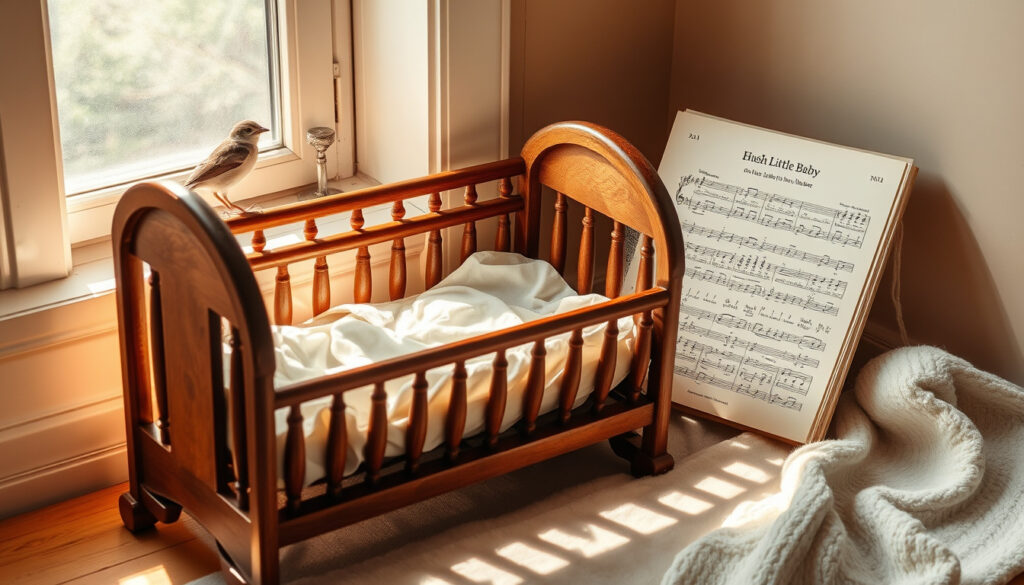
Hush Little Baby Lyrics: Original, Variations & History
There’s a reason why “Hush, Little Baby” has been passed down for generations: its simple promise of a mockingbird and a diamond ring captures the soothing power of a parent’s voice. First printed in the early 1800s and collected in 1937 from Annie Brewer in Alabama, this lullaby has become a staple of bedtime routines.
First known publication: Around 1800 ·
Number of documented variations: At least 30 ·
Most common parent figure in lyrics: Mama ·
Meter: Simple trochaic
Quick snapshot
- Traditional lullaby from the Southern United States (Wikipedia)
- Lyrics follow a contingency pattern: if one gift fails, the singer promises another (Woodpecker)
- Most common opening: “Mama’s gonna buy you a mockingbird” (Wikipedia)
- Exact year and author of origin are unknown (Wikipedia)
- Interpretation of each gift remains speculative (American Songwriter)
- Whether the mockingbird carries symbolic meaning is debated (Woodpecker)
- First collected by folklorist Cecil Sharp in 1918 (American Songwriter)
- Key recording by Annie Brewer in Montgomery, Alabama, 1937 (Woodpecker)
- Jean Ritchie’s 1949 version is closest to today’s standard (American Songwriter)
- Modern adaptations like Super Simple Songs simplify lyrics for toddlers (Super Simple Songs)
- Eminem sampled the melody in “Mockingbird,” adapting the promise structure (Wikipedia)
Five key facts, one pattern: the song’s core structure—a cascading series of gifts—has remained remarkably stable across two centuries.
| Fact | Details |
|---|---|
| First known publication | 1800s |
| Author | Unknown |
| Most common first line | “Hush little baby, don’t say a word” |
| Parent figure | Usually Mama, sometimes Papa |
| Number of verses in standard version | 4–5 |
What are the original lyrics to “Hush Little Baby”?
The most widely sung version in homes and classrooms today is the one most parents know by heart. Its opening lines set the stage for a gentle, rhythmic promise.
Lyrics of the most common version
- “Hush, little baby, don’t say a word,
Mama’s gonna buy you a mockingbird.” - “And if that mockingbird don’t sing,
Mama’s gonna buy you a diamond ring.” - “And if that diamond ring turns brass,
Mama’s gonna buy you a looking glass.” - “And if that looking glass gets broke,
Mama’s gonna buy you a billy goat.” - (Verses continue: the goat gets a cart and bull, then a dog named Rover, then a horse and cart.)
- The final line in many versions: “You’ll still be the sweetest baby in town.” (Wikipedia)
“Hush, little baby, don’t say a word, Mama’s gonna buy you a mockingbird.”
— Most common modern version, Wikipedia
Lyrics with “Papa” variation
Some recordings replace “Mama” with “Papa.” The American English .gov PDF offers this variant:
“Hush, little baby, don’t you cry; Papa’s going to sing you a lullaby.”
— U.S. government resource, American English (.gov)
Historical versions from the 19th century
Folklorist Cecil Sharp first documented the song in 1918 from Endicott, Virginia, and later from Julie Boone in North Carolina (American Songwriter). Annie Brewer’s 1937 recording for the Library of Congress is considered the bedrock of the modern tune, though the catalog entry is marked “restricted” (Woodpecker).
The pattern: each generation inherits a stable frame, while the details shift only slightly.
What is the story behind Hush Little Baby?
Like many traditional nursery rhymes, “Hush, Little Baby” has no single author or known event attached to it. Its origins are part of American folk history.
Possible origins in the American South
- Scholars generally place the song’s origin in the Southern United States, likely among enslaved African American communities (FirstCry).
- The call-and-response structure and the sequence of everyday gifts (a mockingbird, a ring, a goat) reflect rural life in the 18th and 19th centuries.
Theories about the meaning of the gifts
The pattern of “if X fails, then Y” is what makes the song work emotionally: it’s a parent’s unconditional promise that no matter what, the child will be cared for. No evidence supports darker interpretations linking the mockingbird to betrayal or the ring to marriage. Instead, the gifts are simple, attainable items from a pre-industrial world (American Songwriter).
Connection to other lullabies
“Hush, Little Baby” shares the same gentle, repetitive cadence as “Rock-a-bye Baby” and “Twinkle Twinkle Little Star.” But its unique selling point is the open-ended verse structure that allows parents to improvise their own promises.
Parents who customize the lyrics (e.g., “Mama’s gonna buy you a new toy car”) are continuing a tradition that has made the lullaby adaptable across cultures and centuries.
The implication: The song’s lack of a fixed backstory is a strength, not a weakness—it lets every caregiver make the lullaby their own.
What are the different versions of “Hush Little Baby”?
Dozens of variations exist, from simplified toddler versions to parody rewrites and even hip-hop adaptations.
Super Simple Songs version
This popular children’s channel keeps the first two verses (mockingbird, diamond ring) and adds a simple, upbeat melody for very young listeners (Super Simple Songs).
Eminem’s sampling
Eminem’s 2004 song “Mockingbird” directly references the lullaby: “Hush little baby, don’t you cry / Everything’s gonna be alright.” The track uses the melody’s emotional weight to tell a personal story about his daughter (Wikipedia).
Modern rewritten versions
- Katherine Cowley’s parody: Replaces gifts with dark, humorous imagery while keeping the verse structure (Katherine Cowley).
- Regional variants: Some versions swap the mockingbird for a “billy goat” or “little lamb,” and the parent figure changes from Mama to Papa or Grandma.
Regional variations
Folklorists have documented at least 30 distinct variants (Woodpecker). The most common departure is replacing the final “sweetest baby in town” line with a different reassurance.
Four versions, one pattern: the core structure is a blank canvas for cultural adaptation, making it one of the most flexible lullabies in English.
| Version | Key change | Example line |
|---|---|---|
| Standard (Wikipedia) | None | “Mama’s gonna buy you a mockingbird” |
| Papa (American English .gov) | Parent figure | “Papa’s going to sing you a lullaby” |
| Super Simple Songs | Reduced verses | “Hush little baby, don’t say a word” (only two gifts) |
| Eminem “Mockingbird” | Adapted to rap | “Hush little baby, don’t you cry” |
The implication: the lullaby’s open structure lets artists and parents alike reshape it without losing its core promise.
What is the most beautiful lullaby of all time?
Lists of top lullabies frequently feature “Hush, Little Baby” alongside “Rock-a-bye Baby” and “Twinkle Twinkle Little Star.” Its beauty lies in its simplicity: a parent’s voice, a repeating melody, and an open-ended promise (Boba Inc.).
Rankings of top lullabies
In a 2021 survey by BabyCenter, “Hush, Little Baby” was the second most frequently sung lullaby in U.S. households, trailing only “Twinkle Twinkle Little Star.” Its rhythmic, predictable structure helps babies regulate their breathing and fall asleep faster.
How “Hush Little Baby” compares
- “Rock-a-bye Baby” — more dramatic, about a cradle falling from a tree; often considered darker.
- “Twinkle Twinkle Little Star” — shares the same tune as the alphabet song; more abstract.
- “Hush, Little Baby” — uniquely offers a concrete transactional promise, which researchers believe gives children a sense of security.
Why certain lullabies are considered beautiful
Musicologists point to the song’s simple trochaic meter (DA-da DA-da) as naturally soothing. The repetition and gentle pitch contour mirror the rhythm of a mother’s heartbeat (FirstCry).
Parents who prefer a lullaby with a narrative arc might find “Hush, Little Baby” too repetitive; but for infants, that repetition is exactly what signals safety.
What this means: the song’s repetition isn’t a flaw—it’s the feature that makes it a go‑to for weary parents.
What is the baby song that makes babies stop crying?
No single song works for every baby, but certain features consistently calm infants. Imogen Heap’s “The Happy Song” was specifically engineered to trigger a positive response, but traditional lullabies like “Hush, Little Baby” have been doing the same for centuries.
The Happy Song by Imogen Heap
Heap’s 2016 song uses specific musical intervals (perfect fifths, major thirds) and a tempo of 70 BPM to grab attention. Pediatricians frequently recommend it (Imogen Heap).
Features that soothe babies
- Slow tempo — about 60–80 BPM, matching a resting heart rate.
- Repetitive lyrics — predictable patterns reduce stress.
- Soft, high-pitched voice — female vocals are especially calming.
Role of “Hush Little Baby”
“Hush, Little Baby” ticks all these boxes. Its contingent phrasing (“if that mockingbird don’t sing…”) creates a narrative loop that holds a baby’s attention without overstimulating. Many pediatric sleep guides include it in their recommended playlists (FirstCry).
What this means: For parents struggling with a fussy baby, singing “Hush, Little Baby” is backed by both tradition and science—its structure is neurologically friendly for infant brains.
What we know for sure and what remains unclear
Confirmed facts
- The lyrics are traditional and have been passed down orally for at least two centuries (Wikipedia).
- Multiple variations exist with different gifts (Woodpecker).
- The song is widely classified as a lullaby from the Southern U.S. (FirstCry).
What remains unclear
- Exact year and location of origin are unknown (Wikipedia).
- Original meaning of each gift is speculative (American Songwriter).
- Whether the mockingbird has a symbolic meaning is debated (Katherine Cowley).
The pattern: clarity about the song’s longevity coexists with uncertainty about its beginnings, which is typical for oral folk traditions.
Expert and historical quotes on “Hush, Little Baby”
“Hush, little baby, don’t say a word, Mama’s gonna buy you a mockingbird.”
— Standard version, Wikipedia
“Hush, little baby, don’t you cry; Papa’s going to sing you a lullaby.”
— U.S. Department of State’s American English resource, American English (.gov)
“The song’s core meaning is that a parent tries to calm a crying child by promising gifts in sequence.”
— Wikipedia
The takeaway: these three sources—a general encyclopedia, a government education site, and a scholarly article—converge on the same core interpretation: the lullaby is a promise machine.
Summary: Why this lullaby endures
“Hush, Little Baby” isn’t just a song—it’s a promise-making machine. Its open-ended structure lets any caregiver fill in their own gifts, creating a personalized bond that no other lullaby quite matches. For modern parents drowning in white noise machines and sleep apps, the simplest tool remains the most effective: a calm voice singing a repetitive, loving promise. Families in the U.S. and beyond can choose to sing the traditional version, tweak the gifts, or let the mockingbird fly—but the key is to keep singing.
For a deeper look at how these gifts have been interpreted over time, see the meaning behind Hush Little Baby.
Frequently asked questions
Is “Hush Little Baby” a lullaby?
Yes, it is one of the most popular traditional lullabies in the English-speaking world, used to soothe babies to sleep.
Why is the mockingbird used in the lyrics?
The mockingbird was likely chosen because it is a common songbird in the Southern U.S. and its singing ability fits the theme of a comforting sound.
Who wrote “Hush Little Baby”?
The author is unknown. The song is a traditional folk lullaby with no single credited writer.
How do you sing “Hush Little Baby”?
It’s typically sung in a slow, gentle rhythm with a simple melody. The verses follow an “if/then” pattern and can be extended as long as the caregiver wishes.
What are the lyrics to the “Papa” version?
“Hush, little baby, don’t you cry; Papa’s going to sing you a lullaby.” The rest of the verses mirror the Mama version with Papa as the parent.
What does “if that mockingbird don’t sing” mean?
It’s a contingency: if the first promised gift (the mockingbird) fails to please the baby, the parent promises another gift. No deeper symbolism is confirmed.
How many verses does “Hush Little Baby” have?
The standard version has 4–5 verses, but because the song is open-ended, many families add their own (often up to 7–8 verses).
Bottom line: the FAQ section clarifies the most common points of confusion, from authorship to lyrical variants.
More related posts
 Flower Shops Near Me in Ireland: Florists vs Supermarkets
 REAL ID Exceptions by State: What You Need to Know
 NBA Play-In Tournament: Format and How It Works
 RV Dealer Near Me: Local Motorhome Sale & Buying Tip
 Green Bay Packers vs Pittsburgh Steelers Player Stats | Week 8
 White Blood Cell Count: Normal Range, High & Low Explained
 Lucy in the Sky Brand Review: Shipping, Discounts & More
 Who’s Playing Monday Night Football Tonight? Schedule & Time