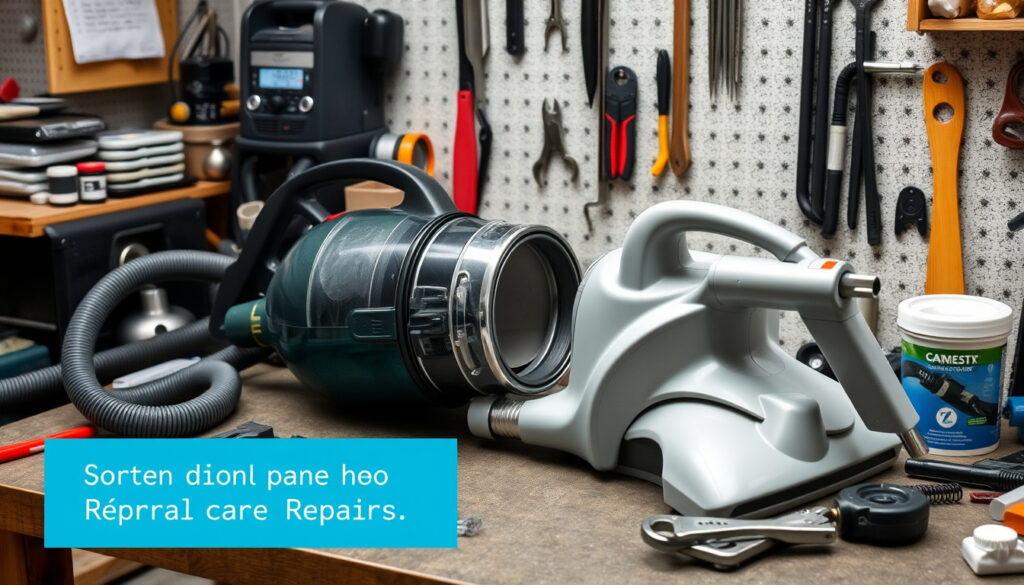
Vacuum Repair Near Me: Cost, Worth & Local Options
Your vacuum just made a noise that sounds expensive. The good news: most common fixes — clogs, belts, brush rolls — run between $50 and $150 at a local shop, and warranty coverage can cancel the bill entirely when the machine is still covered, so whether you pay anything at all hinges on warranty status, vacuum age, and how the repair estimate compares with a new machine — numbers you can check in ten minutes.
Average repair cost: $50–$150 for common issues ·
Dyson average repair cost: $80–$200 ·
Average vacuum lifespan: 5–10 years by brand and usage ·
High-end owners who choose repair: about 30% ·
Most common fault: clogged hose or brush-roll jam
Quick snapshot
- Dyson repairs covered machines at no charge during the warranty period, while out-of-warranty repairs start with an estimate you approve before work begins (per Dyson’s repair & service page).
- Dyson Germany charges a flat €125 for out-of-warranty repairs — including cordless models — with labor and necessary parts included (per Dyson Germany’s repair pricing).
- Shark’s one-year limited warranty covers defective original units from qualifying purchases at authorized retailers (per Shark’s warranty policy).
- Exact US repair costs vary by region, shop, and fault — Dyson doesn’t publish a flat US fee. ((yson’s repair page))
- Whether a repaired vacuum matches the long-term reliability of a new unit isn’t docmented by manufactures. ((yson’s repair page))
- Return-shipping fees on rejected out-of-warranty estimates aren’t published in advance (yson’s repair page).
- Every Shark warranty claim starts by calling 1-877-581-7357 with a purchase receipt (Shark’s warranty policy).
- Battery-powered vacuums usually force their first repair-or-relace decision at year three to five. ((Shark’s warranty policy))
- Act inside the warranty window — manufactuer coverage doesn’t wait for your schedule. ((Shark’s warranty policy))
- Gather your Dyson model number, serial number, purchase date, and delivery details before calling for warranty service.
- Get two written estimates — one from Dyson, one from an independent shop — before approving out-of-warranty work.
- If the machine is under eight years old and the estimate is under half the replacement price, repair is the most economical next step.
Five key numbers, one pattern: warranty coverage and published fees decide the outcome more than the brand on the machine.
| Key fact | Value |
|---|---|
| Average repair cost | $50–$150 for most repairs |
| Dyson average repair cost | $80–$200 for common repairs |
| Average vacuum lifespan | 5–10 years depending on brand and usage |
| Owners who repair high-end vacuums | About 30% |
| Most common vacuum fault | Clog or blockage |
| Shark limited warranty | One year, qualifying purchases from authorized retailers |
| Dyson out-of-warranty fee (Germany) | €125 flat, labor and parts included |
| Dyson motor repair fee (Spain) | €125; €85 for other standard repairs |
| Dyson repair guarantee (Spain) | 12 months on completed repairs |
| Dyson replacement-parts warranty | One year per part or tool |
Is it worth getting a vacuum repaired?
When repair makes sense versus replacement
- The repair estimate is less than half the price of a comparable new model.
- The vacuum is a higher-tier brand — Dyson, Miele, Shark — with years of service left.
- The fault is simple: a clog, a belt, a worn brush roll, or a filter.
- The machine is under five years old and was maintained.
Answer “who pays?” before “can it be fixed?”. A Dyson that fails inside the warranty period is repaired or replaced at no charge, with free machine collection or a Service Center visit. Out-of-warranty repairs start with an inspection and an estimate you approve before any work begins — reject it, and return shipping is on you — and even a covered repair doesn’t reset the warranty clock, which only pauses while the machine is in for service.
A $150 repair on a $700 Dyson is a bargain; the same $150 on a $120 stick vacuum is a bad bet. Brand tier decides the math before the repair shop does.
Cost thresholds for different vacuum brands
- Dyson Germany: flat €125 for out-of-warranty vacuums, labor and parts included (Dyson Germany’s repair pricing).
- Dyson Spain: €125 for motor repairs and €85 for other standard repairs; cordless battery or housing work runs €125, other cordless repairs €85, and completed repairs are guaranteed for 12 months.
Europe’s published list prices are the closest thing the industry has to a transparency benchmark. In the US, estimates arrive after inspection rather than from a price sheet, which is why “vacuum repair near me” produces such different numbers. The takeaway: European list prices set a fair-price guide, and every US repair is a one-off negotiation until manufacturers publish the same.
Assessing the repair versus replacement decision
The cheapest repair is the one the warranty covers. Check the manufacturer’s coverage window first — it can turn a $150 fix into a $0 visit, or expose you to the full price of the work.
Line up three numbers before you commit: the repair estimate, the price of a comparable new vacuum, and the machine’s age. If the estimate is under half the replacement price and the unit is under eight years old, repair is the value play. If the machine is past its tenth year or the motor has failed, most households replace — the math stops working once every fix becomes a negotiation.
The implication: your vacuum’s fate is usually sealed by warranty status and the estimate, not by the brand name — check both before you spend anything.
Is it cheaper to repair or replace a vacuum?
Cost comparison: repair vs. new purchase
- Independent shops typically quote $50–$150 for common faults.
- Comparable new vacuums run $150–$700 depending on type and brand.
- The break-even point sits near 50% of the new price for machines under eight years old.
Four common faults, one pattern: the repair bill almost always lands well below the price of a comparable new machine — until the motor dies.
| Fault | Typical repair cost | Typical new-model price | The smarter call |
|---|---|---|---|
| Clog or blockage | $50–$100 | $150–$700 | Repair — it’s 20–30 minutes of shop time |
| Brush roll or belt | $40–$80 | $150–$700 | Repair — parts are cheap and fast |
| Battery swap (cordless) | $60–$120 | $200–$600 | Repair, unless the machine is 5+ years old |
| Motor or mainboard failure | $150–$250 | $200–$700 | Replace — the fix approaches half the price of new |
Published manufacturer fees land inside that same zone, which makes the table above a fair benchmark rather than a guess.
Factors that affect the break-even point
- The vacuum’s age — repair value drops sharply after year eight.
- Warranty status — a covered machine should never go to a paid shop.
- The fault type — blockages are cheap; motor and battery failures are not.
- Replacement efficiency — newer models often use less power and filter better.
Warranty timing is the pivot: Shark’s one-year limited warranty covers defective original units, and Shark pays the cost to send the unit in — but a fee may apply when the repaired or replacement unit ships back. Inside the window, inbound shipping is covered and repairs are free; outside it, the return fee becomes real money.
Hidden costs of replacement (warranty, disposal)
Replacement carries hidden line items: a short new warranty, the e-waste fee for the old machine, and a fresh set of bags, filters, and accessories on day one. On a borderline quote, those costs quietly flip the math.
Disposal alone rarely decides the question, but it tilts borderline cases. Many municipalities charge a small fee to recycle a vacuum, and a new machine’s accessories add $20–$60 to the real purchase price. When a repair estimate sits within $50 of a replacement’s sticker, those costs can be the tie-breaker.
The trade-off: repair wins when the estimate is under half the replacement price and the fault is mechanical; replacement wins when the motor fails, the unit is old, or the new model’s efficiency gains offset the gap. For most households, the tipping point is a repair quote that clears $200 on a machine older than eight years.
What is the most common problem with the Dyson vacuum?
Common Dyson failures: brush bar, battery, blockage
- Blockages in the wand, bin, or hose — the most common single fault, and the cheapest to fix.
- Brush bar jams — hair and string wrap around the roller and stop it spinning.
- Battery failures on cordless models — typically at year two to four.
- Filter or cyclone clogs that kill suction without stopping the motor.
Dyson Spain’s cordless price list is the tell: battery and housing work runs €125, while other cordless repairs run €85. Battery trouble is the premium repair on cordless machines — the one failure that can push a repair bill toward replacement territory.
Diagnosing the problem before deciding repair
- Check the wand, hose, and bin for blockages first — they cause most suction loss.
- Remove the brush bar and clear hair and string; make sure it spins freely.
- Listen for the motor: power but no suction means airflow, not engine trouble.
- On cordless models, test the battery before assuming the motor is dead.
Diagnosis separates a $60 fix from a $250 one. If the motor runs but nothing picks up, the problem is almost certainly a blockage or a full filter — both cheap to clear. If the brush bar won’t spin, it’s usually hair wrapped around the bearing. Only when the motor grinds, sparks, or stops entirely should you prepare for a large bill.
DIY fixes for typical Dyson issues
- Empty and rinse the bin, then dry it fully before reinstalling.
- Wash the filter every one to three months and let it air-dry completely.
- Cut hair and string off the brush bar with scissors while the machine is unplugged.
- Push a flexible wand or pole through the hose to clear stubborn clogs.
DIY is for maintenance, not surgery. Clearing a clog or washing a filter is safe and takes minutes; opening the motor housing is a different game, and any damage you cause in the process lands on you, not the manufacturer. If the machine has power but the repair involves disassembly, a shop’s $50 diagnostic fee is cheap insurance.
The upshot: most Dyson faults are airflow problems, not engineering failures — and airflow problems are exactly the repairs that make fixing a vacuum worthwhile.
What is the average lifespan of a Dyson vacuum?
Dyson lifespan by model type (upright, canister, cordless)
Upright and canister: 5–10 years ·
Cordless stick: 3–5 years ·
With regular maintenance: add 2–3 years
A well-maintained Dyson typically serves five to ten years, with cordless models on the shorter end because the battery is a consumable part. The German repair price list treats cordless vacuums as standard out-of-warranty service — a sign they’re common enough to have fixed pricing. When a cordless Dyson stops holding a charge at year three or four, a battery-focused repair is often the whole job.
Factors that extend or shorten lifespan
- Wash filters every one to three months to keep motor strain low.
- Clear the brush bar regularly to prevent belt and bearing failure.
- Empty the bin before it’s packed to maintain suction.
- Pet hair and high-pile carpets shorten brush-roll and filter life.
Maintenance is the difference between a five-year machine and a ten-year machine. Blockages clear in minutes, filters wash out, and brush bars shed hair with scissors. The parts that fail with age — motors, batteries, mainboards — are exactly the ones that make replacement look smart.
Signs it’s time to replace your Dyson
A motor repair above $200 on a Dyson older than eight years is the classic replacement trigger. The machine may run again, but seals, hoses, and battery contacts are aging out at the same pace.
Three signals point to replacement: an estimate above half the price of a comparable new model, a second major repair within 12 months, or a machine past its tenth year. In those cases, repair is no longer an investment — it’s a holding action.
Why this matters: your Dyson’s lifespan isn’t set at the factory — it’s set by whether you clear clogs, wash filters, and act on battery problems before they cascade. A machine serviced at year three and year six can easily run to year ten; one ignored rarely makes it to five.
Where can I repair my Dyson?
Authorized Dyson service centers
- Dyson arranges free machine collection for service or an in-person Dyson Service Center visit, starts out-of-warranty work with an approved estimate, and backs replacement parts with a one-year warranty of their own.
For machines inside the warranty window, the manufacturer is the first and best option: the repair is free, collection is arranged, and the process is documented. Out of warranty, the authorized route still has one advantage — original parts and a standardized inspection — but you’ll pay for it, and shipping time adds days to the turnaround.
Big-box store repair services (Best Buy, etc.)
- Best Buy’s Geek Squad accepts vacuums at many locations, with pricing that varies by store and fault.
- Big-box repair usually routes through regional partners, adding shipping days to the process.
A big-box counter is a reasonable second call: it offers a single point of contact, a written estimate, and the convenience of a nearby drop-off. The trade-off is speed and cost — the counter is rarely the cheapest option, and the machine often travels twice before it’s fixed.
Local independent vacuum repair shops
- Search Google Maps for “vacuum repair near me” and filter for shops with strong ratings and review counts.
- Call ahead for a diagnostic fee, a turnaround estimate, and confirmation that they work on your brand.
- Ask what the shop’s repair warranty covers before you approve the work.
Independent shops are where the repair-versus-replace math usually tips toward repair. They charge less than authorized centers, and the work is the same: clear the clog, replace the belt, rebuild the brush roll. The catch is accountability — local guarantees vary, so get the terms in writing. If the machine is inside its manufacturer warranty, use the manufacturer first; outside it, the local shop is the value play. The implication: where you repair is as important as whether you repair — warranty owners go to the manufacturer, while everyone else should compare an authorized quote against a local shop’s quote before approving anything.
Repair or replace: the case for each
Upsides
- Repair costs $50–$150 for most common faults, versus $150–$700 for a new machine.
- Warranty-covered repairs can be completely free — Dyson and Shark both cover qualifying units.
- Repair keeps a high-end machine’s better suction and build quality, and avoids e-waste.
- A local shop can often finish in under an hour, with no delivery wait.
Dowsides
- A repair bill above 50% of replacement cost is wasted money on an old machine.
- Repeat repairs on a vacuum past its eighth year add up fast.
- Out-of-warranty manufacturer repairs may include return-shipping fees.
- No repair restores the efficiency gains of a newer motor or battery.
The pattern: repair wins on cheap mechanical faults and high-end machines; replacement wins on old motors and budget models.
How to handle a vacuum breakdown in five steps
- Check the warranty clock first. If the machine is a Dyson or Shark inside its warranty window, start with the manufacturer, not a repair shop.
- Diagnose before you dial. Clear obvious blockages, empty the bin, wash the filter, and check the brush bar — many “dead” vacuums revive in ten minutes.
- Get two written estimates. One from the manufacturer if the unit is out of warranty, one from an independent shop, and keep the new-machine price in front of you.
- Apply the 50% rule. If the repair estimate is more than half the price of a comparable new vacuum, replacement is the value play.
- Decide with age in view. Under five years, repair almost always wins. Over eight years with a motor or battery failure, replacement usually does.
The takeaway: the five-step loop takes about an hour and prevents most panic-buy replacements.
What’s confirmed, what’s not
Confirmed
- Dyson Germany’s flat €125 out-of-warranty fee includes labor and necessary replacement parts, excluding accessories and filters (Dyson Germany’s repair pricing).
- Dyson Spain’s repair service includes labor and replacement parts, and completed repairs carry a 12-month guarantee.
What’s unclear
- Exact US repair costs vary by region and shop; Dyson doesn’t publish a flat US fee.
- Whether a repaired vacuum matches the long-term reliability of a new unit isn’t documented by manufacturers.
- Return-shipping charges on rejected out-of-warranty estimates aren’t published in advance (Dyson’s repair page).
The trade-off: research confirms the policies and prices; it does not yet confirm the long-term reliability of repairs — so treat any fix beyond the warranty window as a calculated bet.
What the experts say
For a high-end vacuum still inside its first five to seven years of service, repair is usually the more cost-effective call.
Consumer Reports (independent product-testing nonprofit)
Covered machines that fail during the warranty period will be repaired or replaced at no charge, subject to warranty terms.
Dyson (manufacturer repair and service information)
We’ll cover the cost to send your qualifying warranty unit to us for repair or replacement.
SharkNinja (Shark’s warranty policy)
Completed repairs are guaranteed for 12 months or until support for the machine ends, whichever comes first.
Dyson Spain (manufacturer repair pricing)
Every repair decision is a warranty decision wearing a price tag — check coverage first, estimate second, replacement price third, and the answer usually appears on its own. For the household staring at a $120 repair bill on a five-year-old Dyson, the choice is clear: approve the repair and keep a machine you trust, or price a new one — just don’t let a $20 blockage compound into a $500 replacement.
dyson.com, dyson.com, support.sharkclean.com, dyson.es, sharkoffcial.com, thepricer.org
Frequently asked questions
How much does it cost to repair a Shark vacuum?
Inside Shark’s one-year warranty, qualifying defects are covered and inbound shipping is paid; a return fee is possible on the repaired unit. Out of warranty, expect $50–$150 for common faults at an independent shop, with motor and battery work at the top of that range.
Can I repair my vacuum myself?
Yes, for maintenance-level work: clear clogs, wash filters, and free the brush bar. Leave motor, mainboard, and battery replacements to a professional unless you’re comfortable working on live electrical components.
Does a vacuum repair come with a warranty?
It depends on who does the work. Dyson Spain guarantees completed repairs for 12 months, and Dyson replacement parts carry a one-year warranty; independent shops typically offer shorter guarantees, so ask for the terms in writing.
How long does a typical vacuum repair take?
Most common repairs — clogs, belts, brush rolls — take a shop 30–60 minutes once the machine is on the bench. Authorized manufacturer repairs add shipping time; local shops are usually the fastest option.
What is the best vacuum brand for repairability?
Brands with authorized service networks, published repair pricing, and available parts — Dyson, Miele, and Shark in particular — are the most practical to repair. Budget vacuums under $100 rarely justify repair because the labor exceeds the machine’s value.
Can a Dyson be repaired after the warranty expires?
Yes. Dyson’s out-of-warranty service starts with an inspection and an estimate you approve before work begins; if you reject it, return shipping is on you. As a reference point, Dyson Germany charges a flat €125 for out-of-warranty vacuums.
Is it safe to use a vacuum after a minor repair?
Yes, once the repair is done properly: clear the blockage, reseat the filter, and confirm the brush roll spins freely. If the motor smells hot or the machine shuts off repeatedly, stop and take it to a shop.
More related posts
 What Does LMAO Mean? Definition, Usage, and vs LOL
 Jordan 4 University Blue – Release Details, Sizing and Resale Guide
 Chronic Venous Insufficiency Symptoms – Signs, Pain, Stages
 Seahawks vs Tennessee Titans Match Player Stats – Box Score and Top Performers
 How to Write in Cursive: a Step-by-Step Beginner Guide
 Mercy (2026 Film) – Plot, Cast, Trailer and Reviews
 Birds of a Feather: Meaning, TV Series, and Billie Eilish Song
 REAL ID Exceptions: States, Alternatives & Black Star Guide