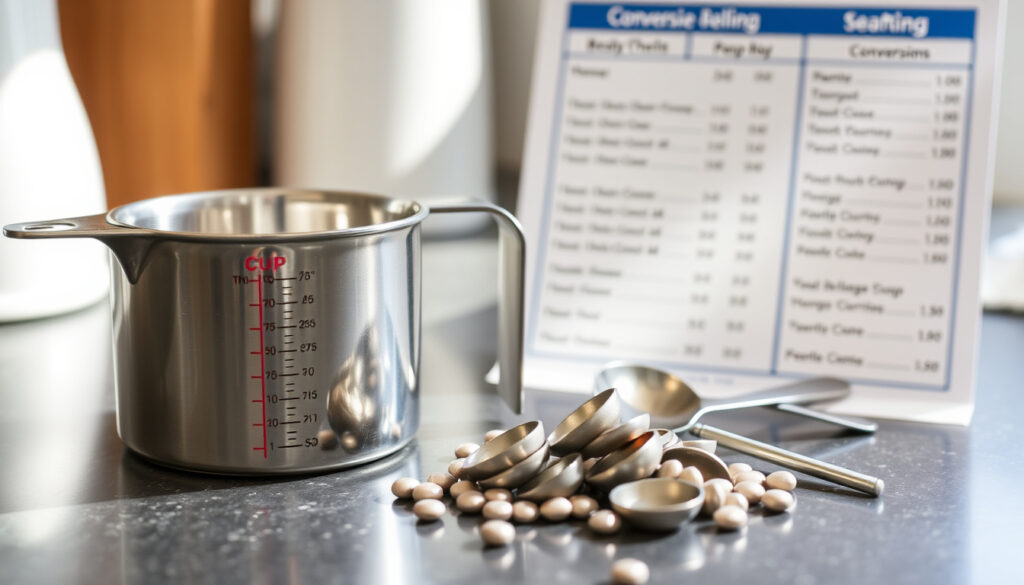
Tablespoons in a Cup: Complete Conversion Guide (With Chart)
You know that moment when a recipe calls for a cup of something and you’re staring at a tablespoon measuring spoon, wondering how many scoops you’ll need? It’s a kitchen puzzle that trips up home cooks and even seasoned bakers. The answer is simple: 16 tablespoons equal 1 cup, but regional differences and common misconceptions make it worth a closer look.
1 cup: 16 tablespoons · 1/2 cup: 8 tablespoons · 1/4 cup: 4 tablespoons · 3/4 cup: 12 tablespoons · 1 US cup (volume): 236.588 ml · 1 Australian cup: 250 ml
Quick snapshot
- 1 US cup = 16 US tablespoons (The Calculator Site cooking conversion guide)
- 1/2 US cup = 8 US tablespoons (The Calculator Site cooking conversion guide)
- 1/4 US cup = 4 US tablespoons (The Calculator Site cooking conversion guide)
- Australian cup = 250 ml = 12.5 Australian tablespoons (The Calculator Site cooking conversion guide)
- Exact conversion for dry vs liquid ingredients (volume remains same but weight differs)
- Whether UK recipes use US or Imperial cups — most modern UK recipes use ml
- Standard cup measures date from 19th-century cookbooks; US customary cup was codified around 1896 by Fannie Merritt Farmer
- Australia shifted to metric in the 1970s, formally adopting 250 ml cups and 20 ml tablespoons in 1974
- Use this guide to unify recipes from US, UK, Australian, and European sources without guesswork
- Try our printable conversion chart for quick kitchen reference
The comparison below shows how each measurement system stacks up.
| Label | Value |
|---|---|
| US cup | 16 US tablespoons (236.588 ml) |
| UK/Imperial cup | 16 Imperial tablespoons (284.131 ml) |
| Australian cup | 12.5 Australian tablespoons (250 ml) |
| US tablespoon | 14.7868 ml |
| Australian tablespoon | 20 ml |
The implication: knowing your measurement system is the first step to accurate scaling.
How many tablespoons are in a cup?
The basic conversion: 1 cup = 16 tablespoons
The bedrock kitchen conversion everyone should memorize: one US customary cup equals 16 US tablespoons exactly. This holds true whether you’re measuring water, milk, or granulated sugar — volume is volume. The Chemistry Store kitchen conversion reference confirms 1 cup = 16 tbsp and 237 ml. That 16-to-1 ratio is what makes scaling recipes so straightforward once you know your fractions.
But here’s where it gets tricky: that 16 tbsp only works when both cup and tablespoon come from the same measurement system. Mix US cups with Australian tablespoons and you get a different number entirely — more on that in the Australia section below.
For US recipes, 16 tablespoons per cup is the fixed constant. Write it on a sticky note and put it on your fridge. Every fraction — half, third, quarter — flows from that number.
Why 8 tablespoons is not 1 cup
A surprisingly common mistake: thinking 8 tablespoons equal a full cup. It’s an easy error because 8 is half of 16, and our brains naturally round. But 8 tablespoons equals exactly ½ cup, not 1 cup. The The Calculator Site cooking conversion guide records ½ cup as 8 tablespoons flat — and that 8 tbsp = 1 cup error shows up in forums and comment sections across the web.
Common measurement systems (US vs UK)
The US customary cup sits at 236.588 ml. The UK (Imperial) cup is bigger at 284.131 ml. That’s roughly 20% more volume. Most modern British recipes have abandoned the Imperial cup in favor of metric (ml), but old cookbooks may still reference it. If you’re using a UK recipe, check whether it specifies “metric” or “Imperial” — a difference of nearly 50 ml can throw off a delicate cake batter. For everyday purposes, stick with US or metric cups for reliability.
Is 4 tablespoons equal to 1/4 cup?
Yes, 4 tbsp = 1/4 cup
This is one of the most searched conversion questions, and the answer is a clean yes. Four US tablespoons make exactly one-quarter cup. The The Calculator Site tablespoon conversion data lists 4 tbsp = ¼ cup in its reference table. That means four scoops of a tablespoon measure will fill a quarter-cup line perfectly.
Does 4 tbsp make 1 cup? (No, it makes 1/4 cup)
It seems obvious once you know, but the question “does 4 tbsp make 1 cup?” gets asked thousands of times a month. The answer is no — 4 tablespoons is one-quarter of a cup. To get a full cup, you’d need four times that amount (16 tbsp). The confusion often comes from doubling recipes: if someone reads “¼ cup = 4 tbsp” and thinks the pattern multiplies linearly, they might mistakenly believe 4 tbsp = 1 cup.
Butter measurement: 4 tbsp butter = 1/4 cup butter
Butter is sold in sticks marked with tablespoon lines. In the US, one standard butter stick equals ½ cup (8 tbsp). So 4 tablespoons of butter — half a stick — equals ¼ cup. This holds true for both salted and unsalted butter, as long as it’s the standard US format. European butter sticks may differ slightly in weight, but the volume conversion remains the same.
Butter measurement by volume (tablespoons) is reliable, but bakers often prefer weight (grams) for accuracy because air pockets can distort volume. Four tablespoons of butter by volume is about 57 grams.
Does 8 tablespoons equal 1 cup?
8 tbsp does not equal 1 cup – it equals 1/2 cup
This misconception is so widespread that cookbook authors and bloggers regularly devote paragraphs to clearing it up. Eight US tablespoons is precisely half a cup, not a full cup. The Exploratorium science education measurement guide lists 8 tablespoons as ½ cup in its official equivalents table. Yet a quick search shows thousands of people asking “is 8 tbsp a cup?” — often mid-recipe.
Is 8 tbsp a half a cup? Yes
Yes, 8 tablespoons equals ½ cup. This is the conversion to rely on when you’re halving a recipe that calls for 1 cup of an ingredient. If you need ¾ cup, that’s 12 tablespoons (8+4). And if the recipe asks for ¼ cup, you already know that’s 4 tablespoons.
Clarifying the common mistake
Why do so many people get this wrong? Partly because 8 feels like a “full” number (half of 16), and partly because measuring cups have lines for ¼, ⅓, ½, ⅔, ¾, and 1, but not for 8 tbsp. Someone who owns only a 1-cup measure might assume eight tablepoons fills it — but it only fills it halfway. The The Calculator Site conversion chart explicitly warns: “8 tablespoons = ½ cup, not 1 cup.”
If you habitually use the 8-tbsp-equals-1-cup shortcut, your recipes will be half their intended yield. For a home cook doubling a soup, that’s annoying. For a baker scaling a wedding cake, it’s a disaster.
How many tablespoons are in 1/2 cup and 3/4 cup?
1/2 cup = 8 tablespoons
Half a cup converts directly to 8 tablespoons. That’s half of the 16-tbsp base. Whether you’re measuring milk, oil, or honey, the volume is consistent. Use this when you need to halve a 1-cup ingredient or when your ½-cup measure is dirty and you have a tablespoon handy.
3/4 cup = 12 tablespoons
Three-quarters of a cup equals 12 tablespoons (8 tbsp for the half plus 4 tbsp for the quarter). This is a handy one for recipes that call for ¾ cup of an ingredient — just pull out your tablespoon measure and count to 12. The The Calculator Site fraction conversion confirms 12 tbsp = ¾ cup.
Is 4 tbsp the same as 1/2 cup? No, it’s 1/4 cup
Four tablespoons is one-quarter of a cup, not half. This is another frequent error: people see “4” and think “half of 8” and mistakenly believe 4 tbsp = ½ cup. The correct fraction is 4 tbsp = ¼ cup. Keep a small conversion chart on your fridge — it saves seconds and avoids ruined batches.
Use the table below for quick lookups.
| Tablespoons | Cups (fraction) | Decimal cups |
|---|---|---|
| 16 tbsp | 1 cup | 1.0 |
| 12 tbsp | 3/4 cup | 0.75 |
| 10.67 tbsp | 2/3 cup | 0.667 |
| 8 tbsp | 1/2 cup | 0.5 |
| 5.33 tbsp | 1/3 cup | 0.333 |
| 4 tbsp | 1/4 cup | 0.25 |
| 2 tbsp | 1/8 cup | 0.125 |
| 1 tbsp | 1/16 cup | 0.0625 |
What this means: Every fraction of a cup has a straightforward tablespoon equivalent. The only tricky ones are the thirds (⅓ cup = 5.33 tbsp, ⅔ cup = 10.67 tbsp), which require a fraction in decimal form. For those, measuring cups marked in thirds are much easier than counting tablespoons.
How many tablespoons are in a cup in Australia?
Australian standard cup = 250 ml (vs US 236.6 ml)
Australia uses a metric cup of 250 ml — larger than the US cup by about 13.4 ml. This difference, while small per cup, adds up across multiple cups in a recipe. The Penguin Books Australia official conversion PDF states that one “North American measuring cup” holds 240 ml (rounded from 236.588), while the Australian cup holds 250 ml. That’s a 4% difference — enough to shift a bread dough’s hydration or a cake’s crumb.
Australian tablespoon = 20 ml (vs US 15 ml)
Here’s the big one: Australia defines its tablespoon as 20 ml, while the US tablespoon is 14.7868 ml (rounded to 15 ml in nutrition labels). The Conversion.org cross-system converter confirms: one US customary cup converts to 11.829411825 Australian tablespoons. For practical use, that rounds to about 11.83. In other words, a US cup is not 16 Australian tablespoons — it’s roughly 12 Australian tablespoons.
Conversion: 1 AU cup = 12.5 AU tablespoons
Using Australia’s own measurements, one Australian cup (250 ml) divided by one Australian tablespoon (20 ml) equals 12.5 tablespoons exactly. This is the conversion Aussie home cooks use internally. The The Calculator Site metric cup conversion lists “1 Australian cup = 12.5 Australian tablespoons” as a standard reference value. For anyone adapting a US recipe to Australian measuring spoons, the ratio is roughly 4 US tbsp = 3 Australian tbsp (since 4×15 ml = 60 ml = 3×20 ml).
This table shows how the two systems compare.
| Unit | US customary | Australian metric |
|---|---|---|
| Cup volume | 236.588 ml (often rounded to 240 ml) | 250 ml |
| Tablespoon volume | 14.7868 ml (rounded to 15 ml) | 20 ml |
| Tbsp per cup | 16 US tbsp | 12.5 AU tbsp |
| US cup → AU tbsp | — | ~11.83 AU tbsp |
How to measure tablespoons in a cup (step by step)
- Start with the right measuring spoons. Use actual tablespoon measuring spoons, not dinner spoons from your cutlery drawer — those can vary by 2-3 ml.
- Determine the target fraction. Do you need ¼, ⅓, ½, ⅔, ¾, or a full cup? Refer to the table above for tablespoon count.
- Scoop and level. For dry ingredients, spoon the ingredient into the tablespoon measure, then level off with a straight edge (knife or spatula). For liquids, fill to the brim without spilling.
- Count carefully. If you need 8 tablespoons for ½ cup, count out 8 level scoops. For 12 tbsp (¾ cup), count 12.
- Check your regional tablespoons. If using Australian spoons, remember 1 US cup ≈ 12 AU tbsp, not 16. Adjust accordingly when following US recipes.
- Use a liquid measuring cup for large volumes. When a recipe calls for more than ½ cup, it’s faster to use a standard measuring cup with lines. 16 tbsp is exactly 1 cup on the cup measure.
Confirmed vs unclear: What we know for sure
Confirmed facts
- 1 US cup = 16 US tablespoons (exact) (The Calculator Site cooking conversion guide)
- 8 US tablespoons = ½ US cup (exact)
- 4 US tablespoons = ¼ US cup (exact)
- Australian cup = 250 ml (Eight Forest Lane kitchen conversion guide)
- Australian tablespoon = 20 ml
- 1 Australian cup = 12.5 Australian tablespoons
What’s unclear
- Exact conversion for dry vs liquid ingredients — volume remains the same, but weight differs significantly (e.g., 1 cup of flour weighs about 120 g, while 1 cup of water weighs 236 g)
- Whether UK recipes still use Imperial cups — most modern UK sources now use metric (ml)
Expert perspectives on measurement accuracy
16 tablespoons equals exactly 1 cup — it’s one of the most reliable conversions in the kitchen.
The difference between US and Australian tablespoon sizes is one of the most common causes of baking fails when following international recipes.
A single cup measurement can differ by up to 3 teaspoons depending on whether you’re using US, metric, or Imperial standards. That’s enough to affect a recipe.
When in doubt, weigh your ingredients. Volume measurements are convenient, but weight (grams) is the only truly universal system for baking.
Summary: What this means for your cooking
Knowing the exact number of tablespoons in a cup is the foundation of accurate cooking and baking. The US standard of 16 tablespoons per cup is simple, but regional differences — especially Australia’s 20 ml tablespoon and 250 ml cup — can throw off results if ignored. For American home cooks, the biggest trap is mistaking 8 tablespoons for a full cup. For anyone using international recipes, the only way to avoid disaster is to check which measurement system the recipe uses and adjust accordingly. A simple conversion chart or a digital kitchen scale removes the guesswork entirely.
For the cook adapting a US recipe in Australia, the choice is clear: either convert each cup to about 12 Australian tablespoons, or, better yet, invest in a set of US-style measuring cups and spoons for international recipes. The alternative — relying on a 20 ml tablespoon — will leave your baked goods dense and your batters off.
For a closer look at the quarter-cup measurement, see our detailed quarter-cup to tablespoon conversion guide.
Frequently asked questions
How many tablespoons in 1/8 cup?
2 tablespoons. 1/8 cup is half of 1/4 cup (4 tbsp ÷ 2 = 2 tbsp).
How many tablespoons in 2/3 cup?
Approximately 10.67 tablespoons. For practical purposes, use 10 tablespoons plus 2 teaspoons (since ⅔ cup = 10 tbsp + 2 tsp).
How many tablespoons in a cup of liquid vs dry?
The volume is the same: 16 tablespoons = 1 cup for both liquid and dry. However, the weight varies — 1 cup of water weighs 236.6 g, while 1 cup of all-purpose flour weighs about 120 g.
Is a US tablespoon the same as a UK tablespoon?
No. The US tablespoon is about 14.8 ml (often rounded to 15 ml). The UK tablespoon is approximately 17.7 ml. The UK also uses a 15 ml tablespoon in many modern metric recipes. Always check which standard your recipe uses.
How many tablespoons in a cup of butter?
8 tablespoons. One standard US butter stick equals ½ cup (8 tbsp). So 2 sticks = 1 cup = 16 tbsp. Butter is usually marked with tablespoon lines on the wrapper.
How many tablespoons in a cup of flour?
16 tablespoons by volume. But because flour is compressible, the most accurate way to measure is by weight (120-125 g per cup). Scooping directly with a measuring cup can add up to 20% more flour.
How many grams in a cup for common ingredients?
It depends on the ingredient: all-purpose flour ≈ 120 g, granulated sugar ≈ 200 g, butter ≈ 227 g, milk ≈ 240 g. For best results, use a kitchen scale for dry ingredients and a liquid measuring cup for wet ingredients.
Related reading
More related posts
 Patio Furniture Near Me: Dublin’s Best Clearance Deals
 Legends of the Fall Cast: Full List, Roles & Behind the Scenes
 Office Depot Near Me – Store Locator, Hours & Services
 iPhone 17 Pro Max Price, Release Date & Specs Guide
 Current Nominations for 97th Academy Awards 2025: Full List
 What Level of RDW Is Dangerous? Normal Range & Risks
 Another Word for Help: 50+ Professional, Polite & Strong Synonyms